Loading market data...
India’s Union Cabinet moves to approve strategic critical minerals agreements with Germany and Canada, strengthening lithium supply, EV manufacturing, renewable energy security, and clean tech supply chains.
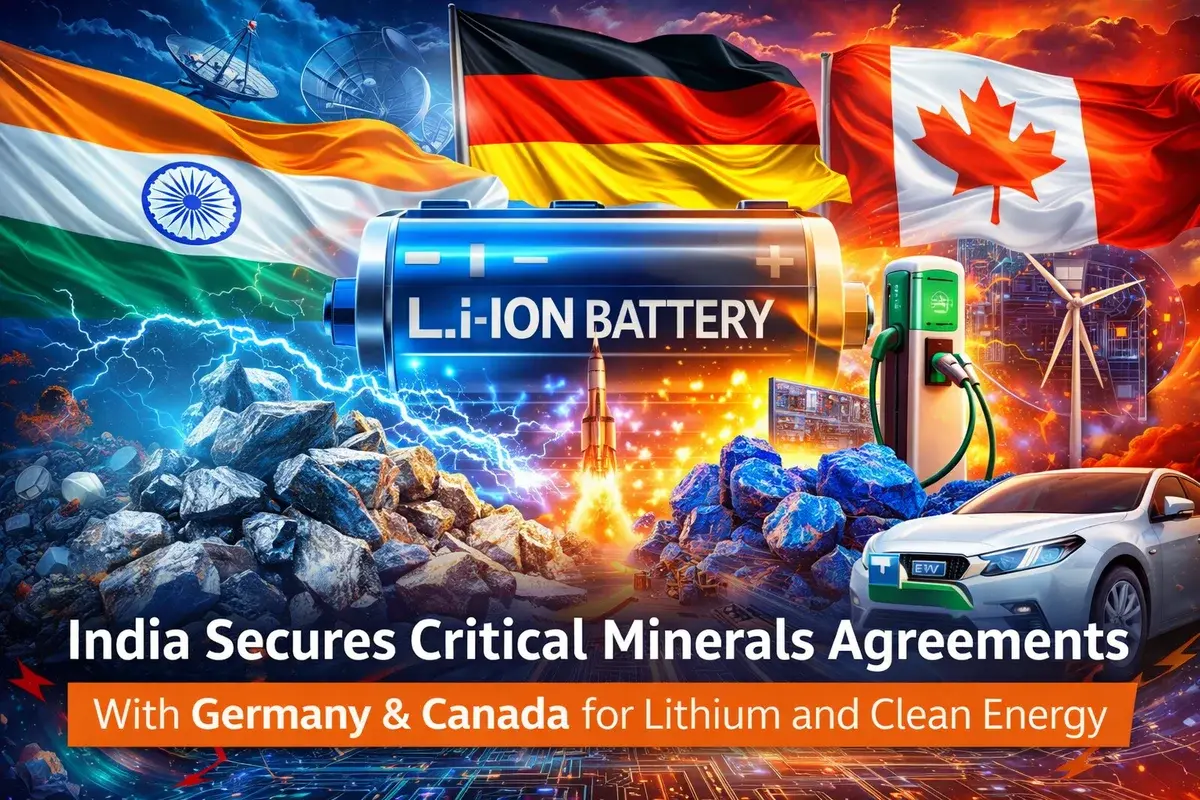
India is on the verge of approving two landmark strategic agreements with Germany and Canada to secure access to critical minerals, the backbone of electric vehicles, renewable energy storage, semiconductors, and advanced manufacturing.
The Union Cabinet led by Prime Minister Narendra Modi is expected to clear these high impact agreements aimed at strengthening India’s mineral security and reducing import dependency.
This move signals a decisive shift in India’s clean energy and industrial policy strategy.
Critical minerals are essential for:
Global demand for lithium is projected to grow more than five times by 2035, driven by electric mobility and renewable energy expansion. Nations are aggressively securing supply chains to avoid overdependence on a limited number of suppliers.
India, currently heavily reliant on imports for battery minerals, is moving to strategically diversify its sourcing and build processing capabilities.
The India Germany pact is expected to focus on:
Collaborative identification and development of overseas mineral blocks.
Adoption of advanced German mining and processing technologies to enhance efficiency and reduce environmental impact.
Strengthening India’s downstream processing capability to convert raw materials into battery grade compounds.
Developing infrastructure for recovery and reuse of critical materials from used batteries and electronics.
Improving sustainability benchmarks across India’s mining ecosystem.
Germany brings technological expertise while India contributes market demand scale, creating a complementary partnership.
Canada is one of the world’s most resource rich nations in:
Canada maintains strong ESG compliance and transparent mining frameworks, making it a reliable long term partner.
For India, this partnership reduces geopolitical concentration risk and diversifies supply beyond dominant mineral exporters.
The global landscape has dramatically shifted.
| Country | Strategic Focus | Objective |
|---|---|---|
| USA | Inflation Reduction Act | Secure domestic battery supply |
| China | Resource acquisition | Vertical integration dominance |
| EU | Critical Raw Materials Act | Reduce China dependence |
| India | Bilateral mineral pacts | Supply chain diversification |
With EV adoption accelerating and clean energy investments surging, control over mineral supply chains is now viewed as economic and strategic leverage.
India aims to become a global EV manufacturing hub. Stable lithium supply is foundational for that ambition.
Domestic gigafactory projects gain long term viability with secure mineral access.
Strategic resource agreements often unlock manufacturing investments.
Reduced exposure to price volatility and geopolitical disruptions.
India can position itself as a clean tech manufacturing alternative in the global value chain.
The agreements could positively impact:
Investors tracking EV stocks, renewable energy stocks, and battery technology companies may see this as a structural policy tailwind.
India currently imports the majority of its lithium and cobalt requirements. Without strategic partnerships, supply bottlenecks could derail clean energy ambitions.
These agreements:
This is not just an economic decision but a long term geopolitical strategy.
India has committed to ambitious climate goals including:
Critical minerals form the backbone of this transition.
Without secured access, renewable ambitions risk slowing down.
While strategically strong, key variables remain:
Execution discipline will determine long term success.
If approved by the Cabinet:
This may also open doors for additional agreements with Australia, Africa, and Latin America.
India’s proposed agreements with Germany and Canada mark a structural pivot toward mineral security and clean tech supply chain independence.
In a world where resource control increasingly shapes economic power, this move positions India proactively.
As EV adoption accelerates, renewable installations rise, and global trade dynamics shift, critical minerals will define the next industrial cycle.
India is ensuring it secures its place in that future.
Why are critical minerals important for India?
They are essential for EV batteries, renewable energy systems, electronics, and defence technologies.
Will this reduce India’s dependence on imports?
Yes. Diversification through partnerships reduces supply concentration risks.
Which minerals are most critical?
Lithium, cobalt, nickel, rare earth elements, and graphite.
How does this impact investors?
It strengthens long term growth visibility in EV, renewable energy, and battery sectors.

Financial journalist specializing in market analysis, stock research, and investment trends. Dedicated to providing accurate, timely insights for informed decision-making.
Credentials: Experienced financial journalist with expertise in equity markets and economic analysis
The information provided in this article is for educational and informational purposes only and should not be construed as financial, investment, or legal advice. Finscann does not provide personalized investment recommendations.
For detailed terms and conditions, please read our Disclaimer and Terms of Service.
No additional articles in this category yet.