Loading market data...
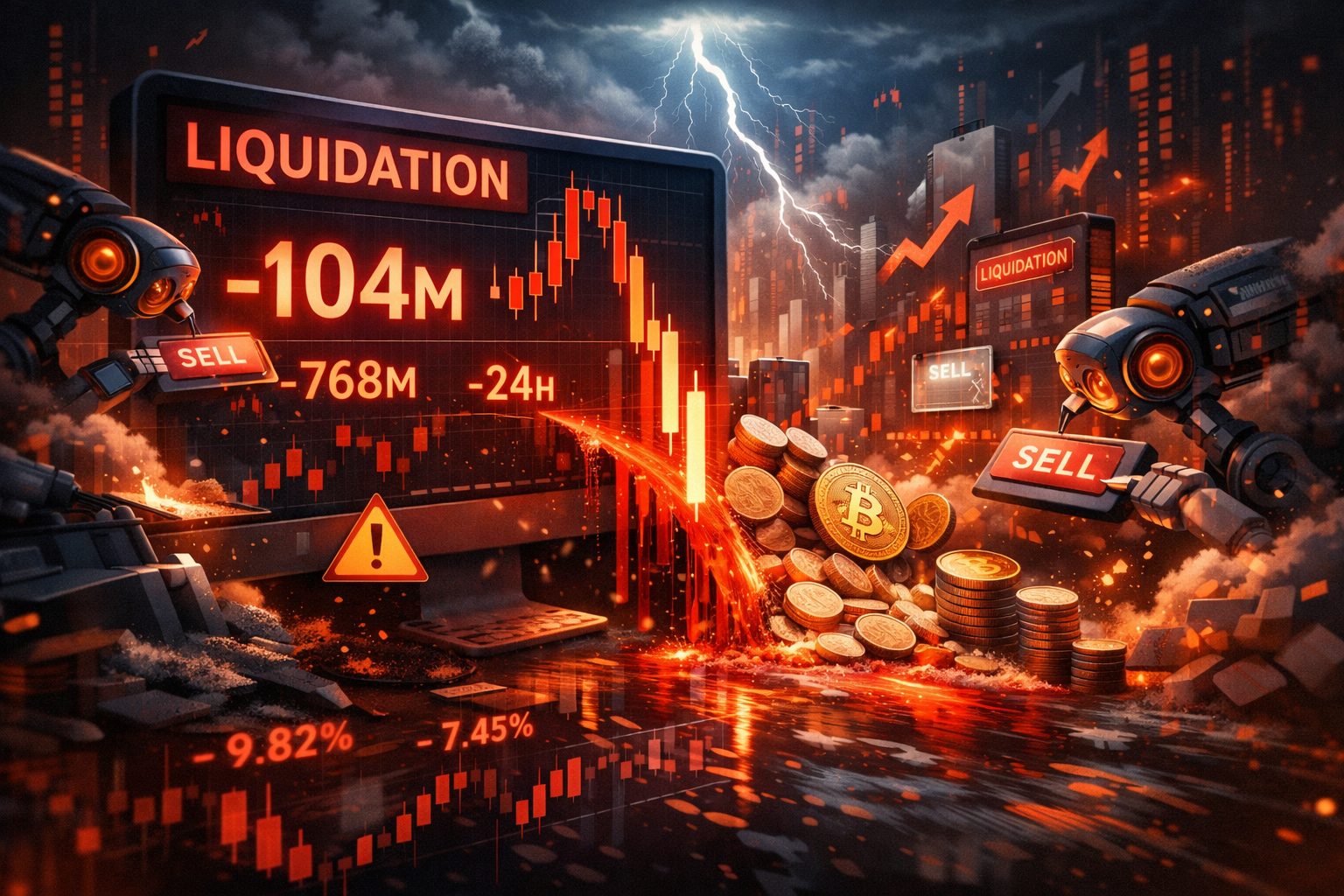
Synopsis: Global crypto derivatives markets were jolted by a violent deleveraging episode as $104 million worth of futures positions were liquidated within a single hour, pushing the 24-hour tally to $768 million. While not unprecedented in historical terms, the speed and concentration of the wipeout reveal a market still running hot on leverage. The episode underscores how thin liquidity, algorithmic trading, and macro-sensitive sentiment can combine to trigger rapid valuation compression in crypto risk assets—sending a clear warning to traders chasing short-term alpha through excessive leverage.
The crypto market’s latest bout of turbulence is not merely another volatility headline—it represents a structural stress test of leveraged digital asset markets. As global risk appetite remains fragile and traders oscillate between momentum and caution, derivatives once again emerged as the epicentre of instability. The episode highlights the widening divergence between spot market conviction and futures-led speculation, a fault line that continues to define crypto’s boom-and-bust cycles.
The Leverage Overhang and the Great Deleveraging Shift The $104 million hourly liquidation event reflects a market where product velocity in derivatives outpaced organic spot demand. Futures markets—particularly perpetual contracts—had been pricing in directional confidence through elevated open interest and aggressive funding rates. When prices moved sharply against these crowded long positions, the unwind was swift, mechanical, and unforgiving.
Unlike gradual corrections driven by fundamentals, liquidation clusters are systemic by design. Once margin buffers fall below maintenance thresholds, exchanges forcibly close positions, transforming unrealized risk into immediate sell pressure. This dynamic accelerates downside moves even in the absence of fresh negative news, reinforcing short-term bearish momentum.
How a Liquidation Cascade Builds Momentum A liquidation cascade typically unfolds in layers, each amplifying the next. An initial price shock breaches key technical levels, triggering margin calls across highly leveraged accounts. Forced market orders then flood the order book, draining liquidity and widening bid-ask spreads. As volatility spikes, algorithmic and high-frequency trading systems further accelerate execution speeds, reinforcing the downward spiral.
Key Liquidity Stress Signals Observed
Major derivatives venues accounted for the bulk of the activity, underscoring where leverage concentration remains highest and risk controls are most frequently tested.
Historical Perspective: Intense, Not Unprecedented While the $768 million in 24-hour liquidations is notable, it remains below the multi-billion-dollar washouts seen during the May 2021 correction or the November 2022 post-FTX collapse. What distinguishes this episode is intensity rather than scale—over $100 million erased within an hour suggests compressed risk buffers and aggressive leverage positioning.
Such events are often linked to a convergence of catalysts, including unexpected macroeconomic data, regulatory signals, large wallet movements onto exchanges, or decisive technical breakdowns below widely watched support levels. The aftershock typically spills into spot markets, where reduced liquidity elevates volatility even for unleveraged participants.
Analyst Insights: What the Street Is Saying “This was not panic selling—it was leverage being forcibly reset,” says a derivatives analyst at a global crypto research firm. “Open interest had built faster than spot volumes could justify. Once price slipped below key supports, the unwind was inevitable.”
Another market strategist highlights the structural takeaway:
Analyst Insights: “Events like this compress risk premiums temporarily but often create cleaner positioning afterward. From a medium-term lens, liquidation flushes tend to reduce downside tail risk once leverage normalizes.”
Analysts broadly agree that:
Exchange Transparency and Systemic Stability
Transparency from exchanges plays a crucial role during liquidation-driven volatility. Real-time visibility into open interest, funding rates, and liquidation data enables market participants to assess leverage risk across the system. Persistently high funding rates often precede long squeezes once momentum falters.
To manage disorderly unwinds, exchanges deploy sophisticated risk engines and insurance funds designed to absorb losses and prevent socialized defaults. The strength of this infrastructure directly influences whether volatility remains contained or escalates into broader systemic stress.
What This Means Going Forward
The $104 million hourly liquidation shock serves as a stark reminder that crypto remains a high-beta, leverage-sensitive asset class. While market structure and liquidity have matured since earlier cycles, leverage continues to act as the accelerant that transforms routine corrections into violent drawdowns.
For traders and investors, the takeaway is clear: understanding leverage mechanics is no longer optional. As the ecosystem evolves, disciplined risk management—not aggressive positioning—will determine who survives periods of turbulence and who is forced out by the next cascade.
What exactly causes a crypto futures liquidation?
A liquidation occurs when a trader’s margin falls below the exchange’s maintenance requirement due to adverse price movement. The exchange automatically closes the position to prevent further losses.
Does high liquidation volume always mean a market crash?
Not necessarily. While it increases volatility, large liquidation events can also mark temporary bottoms if leverage is flushed out and selling pressure exhausts.
Are liquidation cascades driven by manipulation?
In most cases, no. They are typically organic outcomes of excessive leverage combined with sharp price moves, though large traders can sometimes accelerate the process.
How can traders reduce liquidation risk?
Using lower leverage, maintaining excess collateral, setting technically sound stop-losses, and avoiding over-concentration in single positions are key risk-management practices.
Where can real-time liquidation data be tracked?
Several crypto analytics platforms aggregate real-time data from major exchanges, showing liquidation size, dominant positions, funding rates, and open interest trends.
⚠️ DISCLAIMER: We Are Not Financial Advisors The information provided above is for educational and informational purposes only and should not be considered financial or investment advice. Cryptocurrency markets are highly volatile and risky. Readers are strongly encouraged to conduct independent research and consult qualified financial professionals before making any investment or trading decisions.

Financial journalist specializing in market analysis, stock research, and investment trends. Dedicated to providing accurate, timely insights for informed decision-making.
Credentials: Experienced financial journalist with expertise in equity markets and economic analysis
The information provided in this article is for educational and informational purposes only and should not be construed as financial, investment, or legal advice. Finscann does not provide personalized investment recommendations.
For detailed terms and conditions, please read our Disclaimer and Terms of Service.
No additional articles in this category yet.