Loading market data...
Gold prices tumble below $5,000/oz, silver crashes -10% in a flash sell-off. Get FinScann's expert analysis on what triggered this commodity dip and its impact on your portfolio.
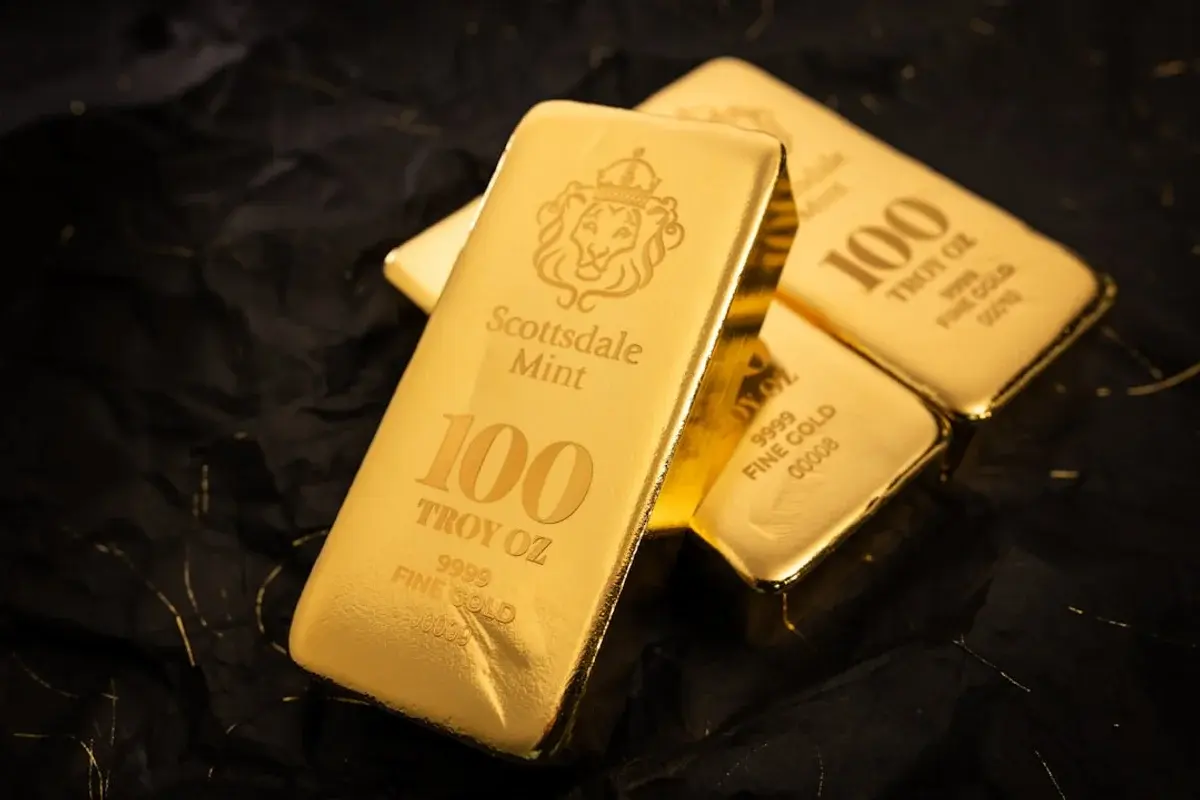
BREAKING: Gold Plunges Below $5,000/oz, Silver Crashes -10% – Latest Commodity Market Analysis February 2026
The global commodity markets witnessed a stunning reversal today as gold prices plummeted -3.5% in a mere 15 minutes, officially dropping back below the critical psychological level of $5,000 per ounce. Compounding the volatility, silver prices experienced an even more dramatic fall, crashing nearly -10% within 30 minutes and sliding below $76 per ounce. This rapid and significant correction in precious metals has sent ripples across financial markets, prompting investors to re-evaluate their safe-haven strategies amidst evolving global economic signals. This sharp downturn, impacting the Multi Commodity Exchange (MCX) in India and global bourses, underscores a fundamental shift in investor sentiment driven by a confluence of macroeconomic factors.
The Catalyst
The precipitous decline in gold and silver prices can be primarily attributed to a strengthening US Dollar (USD) and recalibrated expectations around the US Federal Reserve's (Fed) monetary policy. Recent stronger-than-expected US jobs data has significantly dampened hopes for imminent interest rate cuts by the Fed, leading traders to push back expectations for the next rate cut to July or even later in 2026. As interest rates are expected to remain "higher for longer," non-yielding assets like gold and silver become less attractive compared to interest-bearing alternatives.
A firmer US Dollar also intrinsically puts pressure on dollar-denominated commodities. When the dollar strengthens, precious metals become more expensive for holders of other currencies, thereby reducing demand. This inverse relationship has been a significant driver of today's sharp sell-off. Furthermore, profit booking by investors after a prolonged period of record-breaking gains in both metals has accelerated the correction, especially during periods of high liquidity. Geopolitical tensions and concerns over global economic stability, while still present, seem to be momentarily overshadowed by hawkish monetary policy signals and a "risk-on" sentiment returning to some equity markets.
Financial Forensics
Today's price action marks one of the most abrupt short-term reversals in precious metals in recent memory. Gold, which had been trading just above the $5,000/oz mark, saw aggressive selling pressure pushing it down rapidly. Similarly, silver, known for its higher volatility due to its dual role as a precious metal and industrial commodity, experienced an even steeper percentage drop.
Precious Metals Price Movement (February 12, 2026)
| Commodity | Prior Price (approx.) | Price after Drop | Percentage Change | Timeframe of Drop |
|---|---|---|---|---|
| Gold | ~$5,175/oz | ~$4,995/oz | -3.5% | 15 minutes |
| Silver | ~$84/oz | ~$75.6/oz | -10.0% | 30 minutes |
| Source: FinScann Analysis |
On the Indian Multi Commodity Exchange (MCX), this global trend is expected to translate into significant downward pressure. While specific real-time MCX figures for this exact intraday event are still developing, historical data from earlier this month indicates that MCX gold and silver futures have previously reacted sharply to global cues, hitting lower circuit levels on instances of intense profit booking and dollar strength. The current USDINR exchange rate hovering around ₹90.63 means that a $5,000/oz gold price would approximately translate to ₹15,000 per gram (considering 1 troy ounce = 31.1035 grams).
Market Impact
The sudden depreciation in gold and silver prices is likely to impact various segments of the Indian financial market. Equity markets, particularly sectors like jewellery manufacturers and those reliant on silver as an industrial input, could see mixed reactions. Earlier in February 2026, Indian equity benchmarks, including the Sensex and Nifty 50, have shown resilience or traded with mixed cues, largely influenced by global market signals and domestic earnings reports. A sharp fall in commodities might divert some investment flow back into equities, particularly if the narrative shifts towards stronger economic growth and reduced inflation concerns globally. However, a significant correction in precious metals could also trigger broader risk aversion if perceived as a sign of deeper economic distress.
The Reserve Bank of India (RBI) recently maintained its key repo rate at 5.25% in its February 2026 monetary policy meeting, indicating confidence in a softer inflation outlook and improving growth prospects for India. While the RBI's stance is neutral, global interest rate dynamics, particularly from the Fed, will continue to exert influence on investor sentiment towards commodities in India.
Key Takeaways for Investors
FinScann Verdict
The abrupt crash in gold and silver prices is a stark reminder of the dynamic nature of commodity markets. While immediate triggers point to US Dollar strength and shifting rate expectations, Indian investors must stay vigilant. This period demands a data-driven approach, carefully assessing global macroeconomic signals and their localized impact on the MCX and the broader Indian economy before making any investment decisions. The "higher for longer" narrative from major central banks appears to be setting the tone for precious metals in the near term.
Q: What triggered the recent sharp fall in gold and silver prices? A: The primary triggers for the recent sharp fall in gold and silver prices include a strengthening US Dollar (USD) and revised expectations for US Federal Reserve interest rate policy. Stronger US jobs data has reduced the likelihood of imminent rate cuts, making non-yielding precious metals less attractive. Additionally, significant profit booking by investors after a strong rally contributed to the accelerated sell-off.
Q: How does a stronger US Dollar influence precious metal prices? A: A stronger US Dollar generally has an inverse relationship with precious metal prices, especially gold and silver. Since these commodities are predominantly priced in USD globally, an appreciating dollar makes them more expensive for buyers holding other currencies. This reduced purchasing power effectively lowers demand and puts downward pressure on prices.
Q: Is it a good time for Indian investors to buy gold and silver after this dip? A: This depends on an individual's investment horizon and risk appetite. For long-term investors seeking to diversify their portfolio or hedge against potential future inflation and geopolitical risks, significant dips could present an accumulation opportunity. However, short-term investors should remain cautious as volatility is expected. It is crucial to consult a SEBI-registered financial advisor to align any investment decision with personal financial goals.
Q: What is the short-term outlook for precious metals? A: The short-term outlook for precious metals like gold and silver appears volatile, influenced largely by global economic data, particularly from the US, and statements from major central banks regarding interest rates. Continued US Dollar strength and the "higher for longer" interest rate stance could maintain downward pressure. However, any resurgence in global economic uncertainty or a weakening dollar could provide support. Investors should prepare for continued price swings.
Q: How does this global commodity drop impact the Indian economy and local gold prices (MCX)? A: The global drop in gold and silver prices directly impacts local prices on the MCX. While Indian domestic demand (especially for jewellery) provides some floor, a significant global price correction, exacerbated by a strong US Dollar, translates to lower prices in ₹ terms. This can reduce import bills for India but might affect domestic gold dealers and investors who bought at higher price points. The RBI's stable repo rate, however, provides a measure of domestic financial stability.
Disclaimer: For information only; not investment advice. Stock market investments carry risks. Please consult a SEBI-registered advisor before investing. FinScann assumes no liability for decisions made based on this report.

Financial journalist specializing in market analysis, stock research, and investment trends. Dedicated to providing accurate, timely insights for informed decision-making.
Credentials: Experienced financial journalist with expertise in equity markets and economic analysis
The information provided in this article is for educational and informational purposes only and should not be construed as financial, investment, or legal advice. Finscann does not provide personalized investment recommendations.
For detailed terms and conditions, please read our Disclaimer and Terms of Service.
Gold and silver rates jump on MCX today amid dollar weakness and escalating US-Iran conflict.

Global crude oil prices have soared by 18% this week, with Brent nearing $85/barrel. FinScann analyzes the Middle East crisis, Strait of Hormuz...
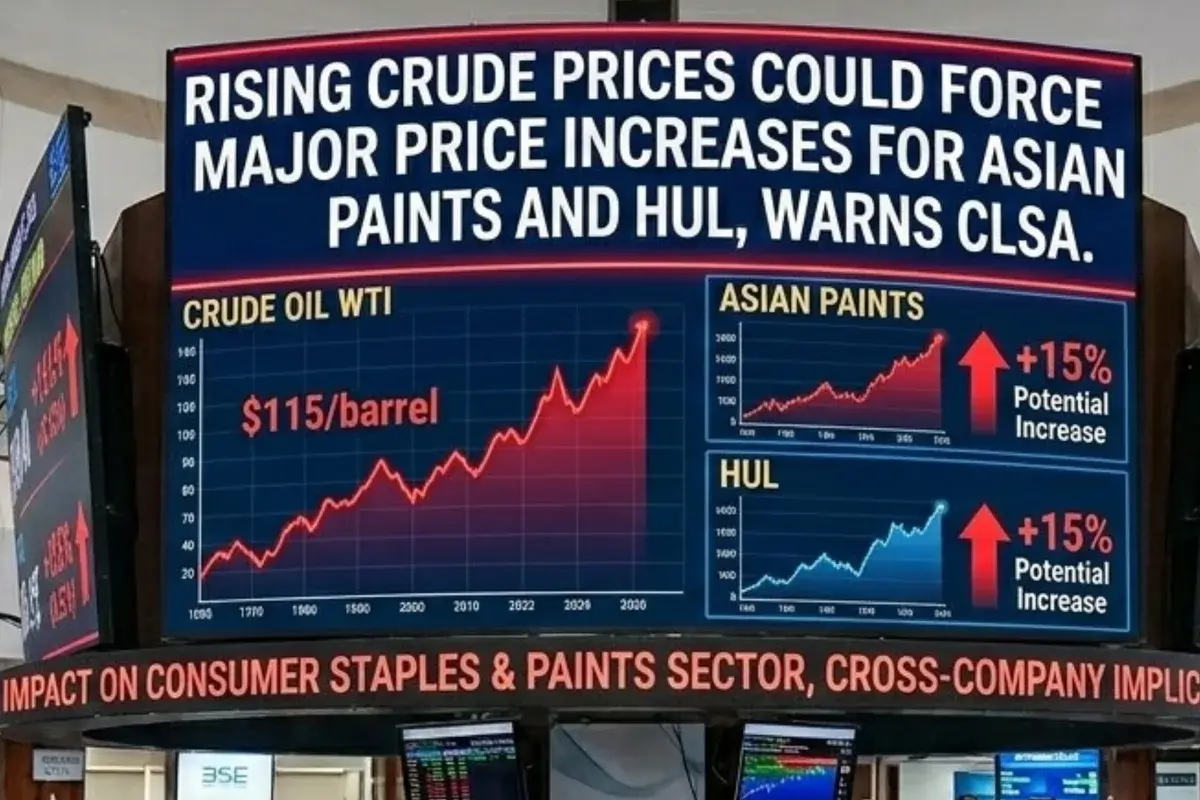
Surging crude oil prices could force major price increases for Indian giants Asian Paints and HUL, warns CLSA.
Gold prices on MCX soar to ₹1.64 lakh in March 2026, driven by intense US-Iran tensions. FinScann analyzes safe-haven demand and future outlook for...
Silver prices soar over 3% in March 2026 as Middle East tensions escalate and a weaker US dollar fuels safe-haven demand.