
Adani Aerospace–Embraer Deal Explained: Why India’s First Commercial Aircraft Assembly Line Is a Game Changer
1 hours ago
Reviewed and Rewrite by
Shanaya Singh
Synopsis
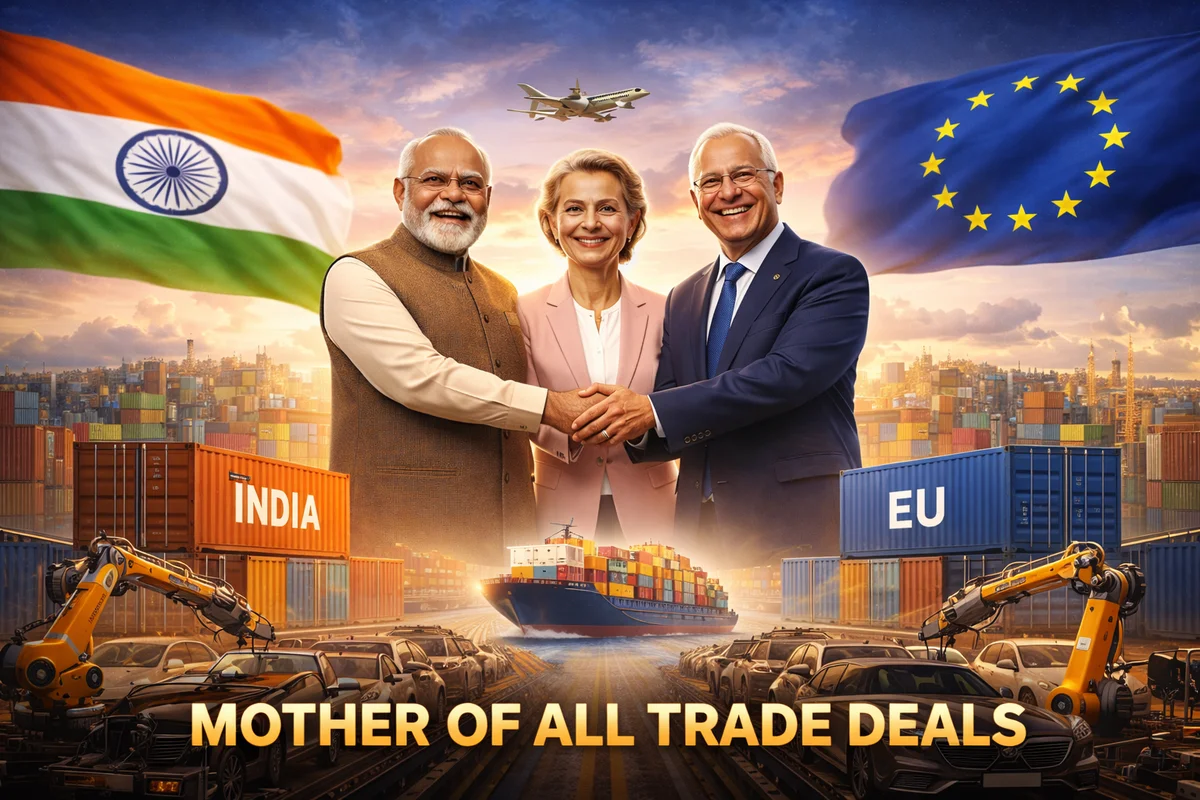
Prime Minister Narendra Modi on Tuesday described the newly concluded India–European Union Free Trade Agreement (FTA) as the “mother of all trade deals,” calling it a transformational pact that will reshape India–EU economic ties across trade, manufacturing, defence, climate action, and technology. The agreement, announced at the 16th India–EU Summit in New Delhi, is expected to come into force next year after legal scrubbing and ratification.
A Historic India–EU Moment at the 16th Summit
India and the European Union formally concluded negotiations on the long-awaited Free Trade Agreement at the 16th India–EU Summit, hosted in New Delhi by Prime Minister Narendra Modi. The summit was attended by Ursula von der Leyen and Antonio Costa, underscoring the strategic importance both sides attach to the partnership.
Commerce Secretary Rajesh Agrawal confirmed that negotiations have been concluded and that the formal signing of the FTA is expected in about six months, following legal vetting. The deal is likely to come into effect sometime in 2027.
Why This Deal Is Being Called the “Mother of All Deals”
Unlike traditional trade agreements focused mainly on tariffs, the India–EU FTA is broad, deep, and strategic, covering a wide spectrum of economic and geopolitical areas.
Prime Minister Modi said the pact would:
• Boost manufacturing and services
• Expand exports and investment flows
• Strengthen supply-chain resilience
• Deepen strategic and defence cooperation
The agreement also complements India’s recent trade arrangements with other major economies, positioning India as a central player in global trade realignment.
Table 1: Key Pillars of the India–EU Free Trade Agreement
| Area | What the Deal Covers | Why It Matters |
|---|---|---|
| Trade in goods | Tariff reduction, rules of origin | Improves market access for exporters |
| Services | IT, finance, mobility | Boosts India’s services exports |
| Investment | Investor protections | Attracts long-term EU capital |
| Defence & security | Joint frameworks | Strengthens strategic cooperation |
| Climate & clean energy | Green tech, transition | Supports net-zero ambitions |
| Technology | Critical & emerging tech | Reduces dependence on rivals |
Strategic Timing Amid Global Trade Turmoil
The timing of the India–EU FTA is crucial. Global trade is currently facing:
• Rising protectionism • Tariff wars led by major economies • Supply-chain fragmentation • Heightened geopolitical risk
For Europe, the deal is part of a strategy to reduce over-dependence on the US and China. For India, it offers a pathway to diversify export markets and attract high-quality foreign investment.
Defence, Security, and Strategic Cooperation
Beyond trade, the summit is expected to unveil a defence and security cooperation framework, marking a major step in India–EU strategic alignment.
Officials said the framework may include:
• Indian participation in European defence initiatives • Joint research and development • Maritime and cyber-security cooperation
This reflects a shift in the relationship from purely economic engagement to a strategic partnership.
Market and Economic Impact: What Changes for India?
The India–EU FTA is expected to have wide-ranging economic implications.
Key sectors likely to benefit:
• Textiles and apparel
• Jewellery and gems
• Engineering goods
• Automobiles and auto components
• IT and professional services
Equity markets are expected to track sector-specific announcements closely as finer details of the agreement emerge.
Table 2: India–EU Trade Snapshot (Then vs Now)
| Metric | Earlier Period | Current Outlook |
|---|---|---|
| Bilateral trade value | €4.4 bn (1980) | Set to expand sharply |
| EU share in India trade | Over 20% (early 2000s) | Strategic rebalancing |
| India share in EU trade | <1% | Expected to rise |
| Nature of engagement | Trade-focused | Strategic + economic |
A Long Road to Agreement
India–EU trade negotiations have spanned decades. While the EU was once India’s largest trading partner, changing global dynamics stalled progress.
The 2026 agreement represents a modern reset, aligning trade rules with today’s realities of digital commerce, climate transition, and geopolitical competition.
What Happens Next?
According to officials:
• Legal scrubbing and ratification will take around six months • The agreement could come into force next year • Sector-specific implementation timelines will follow
Businesses on both sides are already preparing for new compliance frameworks and market opportunities.
FAQs: India–EU Free Trade Agreement Explained
What is the India–EU Free Trade Agreement?
It is a comprehensive trade and strategic partnership pact aimed at reducing trade barriers, boosting investment, and deepening cooperation across multiple sectors.
Why is PM Modi calling it the ‘mother of all deals’?
Because of its scale, depth, and long-term impact across trade, manufacturing, services, defence, and technology.
When will the India–EU FTA come into force?
The deal is expected to be signed in about six months and could take effect sometime next year.
Which sectors in India benefit the most?
Textiles, jewellery, manufacturing, services, and export-driven industries are expected to gain significantly.
Does the deal include defence cooperation?
Yes. A defence and security framework is expected to be unveiled alongside the trade agreement.
How does this affect India’s global trade position?
It strengthens India’s integration into global supply chains and positions it as a key alternative manufacturing and services hub.
Why is this deal important for Europe?
Europe is seeking to diversify trade partnerships and reduce reliance on the US and China amid rising geopolitical risks.
Final Take
The conclusion of the India–EU Free Trade Agreement marks a watershed moment in India’s trade diplomacy. More than a tariff pact, it represents a strategic alignment between two major economic blocs at a time of global uncertainty.
If implemented effectively, the agreement could reshape trade flows, boost investment, strengthen security cooperation, and elevate India’s role in the global economic order — truly living up to its billing as the “mother of all trade deals.”