

market
Market Outlook Jan 27: Nifty & Sensex Target Recovery as Gift Nifty Signals Positive Start
59 minutes ago
Reviewed and Rewrite by
Shanaya Singh


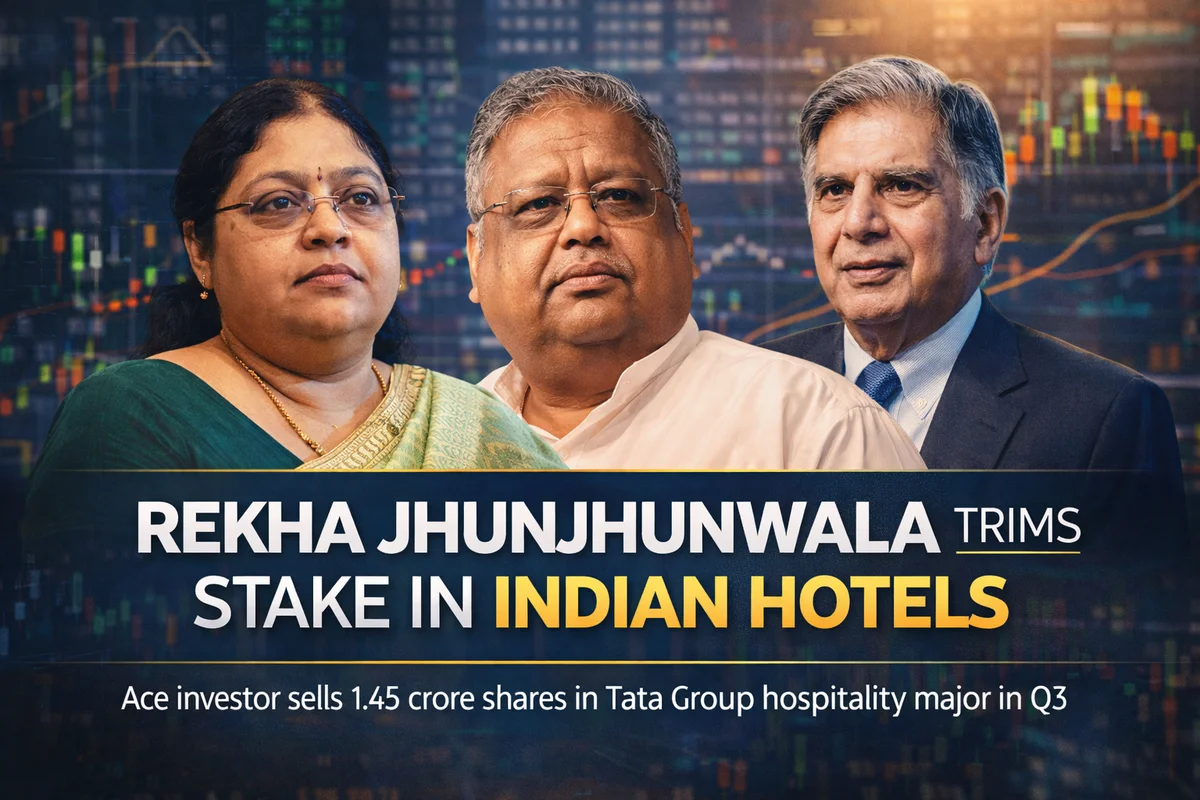
Rekha Jhunjhunwala Portfolio Update: Ace Investor Cuts Stake in Tata Group’s Indian Hotels in Q3 — Should Retail Investors Be Concerned?
Introduction: A High-Profile Portfolio Move That Has Caught Market Attention
When an ace investor makes even a marginal portfolio adjustment, the market takes notice. That is exactly what happened in Q3 FY26, when Rekha Jhunjhunwala, one of India’s most closely tracked investors and the wife of late market legend Rakesh Jhunjhunwala, pared her stake in Tata Group company Indian Hotels.
According to disclosures available on the BSE, Rekha Jhunjhunwala sold 1,45,23,200 shares, representing a 1.02% stake in Indian Hotels during the December quarter. The move comes at a time when the stock has underperformed the broader market across multiple time frames, prompting investors to ask an important question:
Is this a tactical trim, or a signal retail investors should take seriously?
This article examines what exactly changed in Rekha Jhunjhunwala’s portfolio, how Indian Hotels has performed, why the stock may have underperformed in the near term despite strong long-term returns, and what investors should realistically read into this portfolio reshuffle.
Who Is Rekha Jhunjhunwala and Why Her Portfolio Matters
Rekha Jhunjhunwala is among India’s most influential investors, known for her long-term, conviction-based investment approach. Following the passing of Rakesh Jhunjhunwala, she continues to manage one of the most tracked portfolios in the Indian stock market.
According to publicly available data:
She holds stakes in 27 listed companies Her publicly disclosed portfolio is valued at over ₹45,023 crore Most of her holdings have remained largely unchanged, underscoring a long-term orientation
Because of this consistency, any deviation — even a partial stake cut — draws heightened scrutiny from retail and institutional investors alike.
The Q3 Move: Stake Cut in Indian Hotels Explained
During Q3 FY26, Rekha Jhunjhunwala reduced her holding in Indian Hotels, a Tata Group hospitality major.
Key details of the transaction
Company: Indian Hotels Company Ltd Shares Sold: 1,45,23,200 Stake Reduced: 1.02% Quarter: Q3 FY26 Remaining Stake: ~1% Shares Held Post Sale: 1,42,87,765
Even after the sale, Jhunjhunwala continues to remain a shareholder, indicating that this is not a full exit, but rather a portfolio rebalancing move.
Why Did Rekha Jhunjhunwala Trim Her Stake?
While no investor publicly discloses exact reasons for every transaction, several logical factors emerge from the data.
Short-Term Underperformance of Indian Hotels Stock
Indian Hotels has underperformed the broader market across all major time frames over the past year.
One Year: Indian Hotels -17%, BSE Sensex +6.5% Six Months: Indian Hotels -14%, BSE Sensex -1.4% Year to Date: Indian Hotels -13%, BSE Sensex -4%
Such sustained underperformance often leads large investors to rebalance exposure, even if long-term conviction remains intact.
Portfolio Rejigging Rather Than Exit
The fact that Rekha Jhunjhunwala only trimmed 1.02% and still holds a meaningful stake suggests:
Profit protection Capital reallocation Tactical risk management
This is not indicative of a loss of confidence, but rather active portfolio management.
Indian Hotels: A Tata Group Hospitality Giant
Indian Hotels Company Ltd, part of the Tata Group, operates iconic hospitality brands including Taj, Vivanta, and Ginger.
The company benefits from:
Strong brand recall Leadership in luxury hospitality Exposure to domestic tourism growth Tata Group governance standards
However, hospitality stocks are highly sensitive to macro cycles, cost inflation, and discretionary spending trends.
Why Has Indian Hotels Underperformed Recently?
Despite strong long-term fundamentals, the stock has struggled in the near term.
Possible reasons include:
Rising operational costs Margin pressure from wage and input inflation Normalisation of post-pandemic travel demand Profit booking after a strong multi-year rally Broader market rotation away from discretionary consumption
These factors can weigh on sentiment even in fundamentally strong companies.
Long-Term Perspective: A Proven Multibagger
While recent performance looks weak, long-term investors have been handsomely rewarded.
Five Years: +443% Ten Years: +550%
This clearly establishes Indian Hotels as a long-term wealth creator, making the recent correction look more like a consolidation phase rather than structural damage.
Does a Stake Cut by a Marquee Investor Mean Sell?
This is where many retail investors misinterpret portfolio disclosures.
Important reality check
Marquee investors rebalance for portfolio-level reasons Their time horizon may differ from retail investors Partial stake cuts are often risk-management tools They do not necessarily reflect a bearish view on the business
In this case, the continued ownership of Indian Hotels by Rekha Jhunjhunwala is a critical signal.
Jhunjhunwala Portfolio Still Heavily Tilted Toward Tata Group
Even after trimming Indian Hotels, Rekha Jhunjhunwala continues to hold multiple Tata Group stocks, including:
Tata Motors Commercial Vehicles Tata Motors Passenger Vehicles Tata Communications Titan Company
This reinforces her long-term confidence in the Tata ecosystem, governance, and business resilience.
Retail Investor Psychology: Why These Moves Matter So Much
Retail investors often track marquee portfolios because:
They provide insight into institutional thinking They highlight sectoral trends They signal where smart money is cautious or confident
However, blindly copying trades without context can be risky.
How Retail Investors Should Interpret This Development
Instead of reacting emotionally, investors should ask:
Has the business fundamentally deteriorated? Is underperformance cyclical or structural? Does the company still have long-term growth drivers? Am I aligned with the same time horizon?
In Indian Hotels’ case, long-term fundamentals remain intact, even as short-term performance lags.
What This Means for Existing Shareholders
If you already own Indian Hotels:
Short-term volatility is expected Long-term wealth creation track record remains strong Monitoring margins and occupancy trends is key Management commentary matters more than portfolio moves
A partial stake cut by a marquee investor should not be the sole reason to exit.
What This Means for New Investors
For new investors:
Corrections often offer better entry points Valuation comfort is essential Long-term horizon is critical in hospitality stocks Risk management remains key
Indian Hotels remains a high-quality business, but patience is required.
Common Mistakes Retail Investors Make in Such Situations
Panic selling on portfolio disclosures Ignoring long-term performance Chasing short-term sentiment Assuming one investor’s move equals a market signal
Smart investing requires context, not reaction.
Frequently Asked Questions
Did Rekha Jhunjhunwala exit Indian Hotels completely?
No. She trimmed her stake by 1.02% and continues to hold around 1%.
Why did Indian Hotels underperform recently?
Due to market rotation, margin pressure, and profit booking after a strong rally.
Is Indian Hotels still a good long-term stock?
Historically, it has delivered strong long-term returns, but near-term volatility remains.
Should retail investors follow marquee investors blindly?
No. Portfolio moves should be interpreted with context and personal risk assessment.
Does this signal trouble for Tata Group stocks?
No. Rekha Jhunjhunwala continues to hold several Tata Group companies.
The Bigger Picture: Portfolio Rebalancing Is Not a Verdict
Portfolio disclosures often create noise, but experienced investors understand that portfolio management is dynamic.
A small stake reduction does not erase:
Strong brand power Long-term demand tailwinds Proven wealth creation history
Markets reward patience and understanding, not knee-jerk reactions.
Conclusion: A Tactical Trim, Not a Red Flag
Rekha Jhunjhunwala’s decision to reduce her stake in Indian Hotels during Q3 FY26 appears to be a tactical portfolio adjustment, influenced by near-term underperformance rather than a loss of faith in the business.
With Indian Hotels still delivering multibagger returns over longer horizons, the move should be seen as a reminder for investors to:
Track fundamentals over sentiment Separate short-term noise from long-term value Avoid overreacting to portfolio reshuffles
For retail investors, the key takeaway is clear:
Understand the business first — not just who is buying or selling it.
Disclaimer: This article is for informational and educational purposes only and should not be construed as investment advice. The views expressed are based on publicly available information and market data. Stock market investments are subject to market risks. Readers are advised to conduct their own research and consult a certified financial advisor before making any investment decisions. Neither the author nor the publisher is responsible for any financial losses arising from decisions based on this article.