Loading market data...
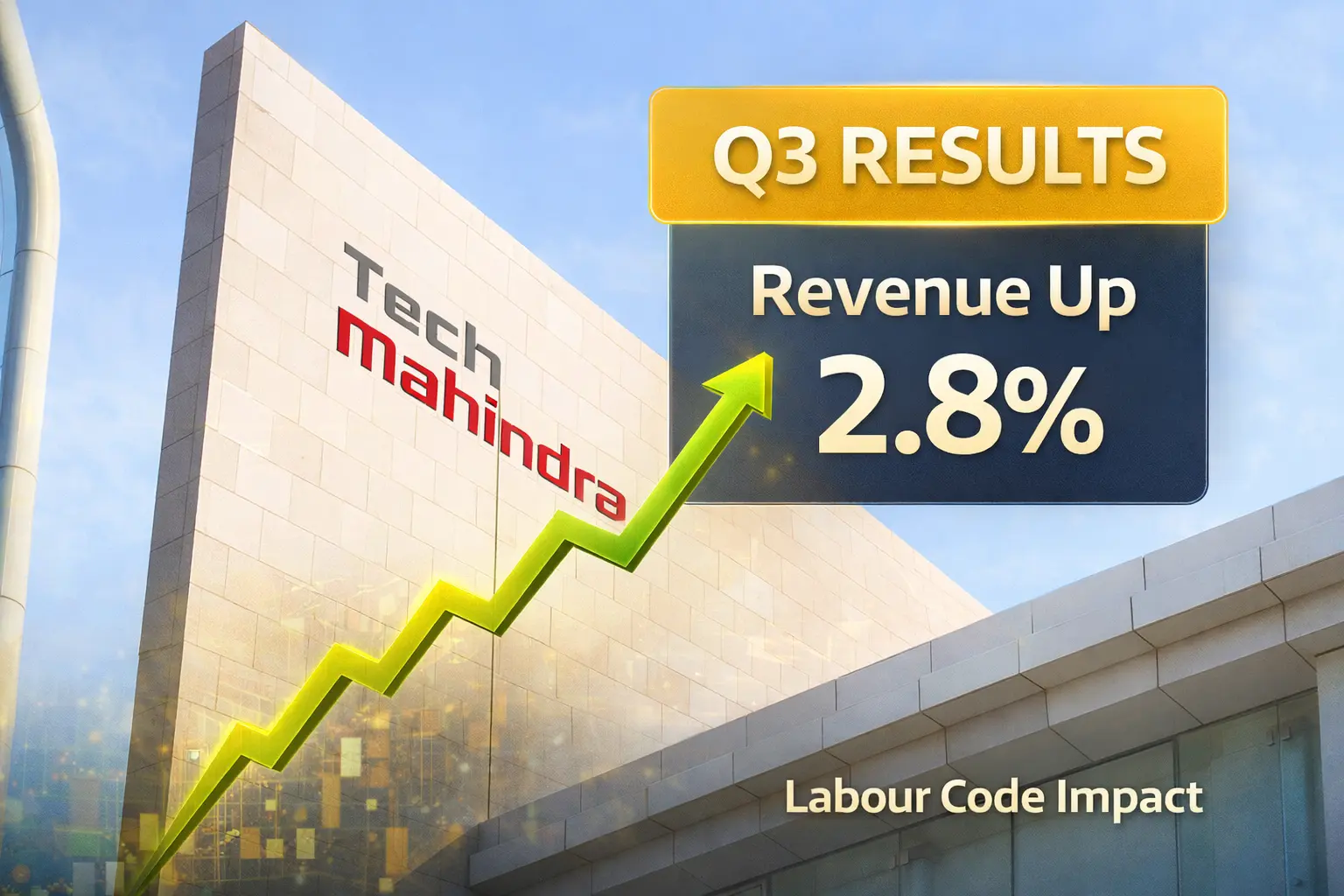
Synopsis: Tech Mahindra delivered its fastest quarterly revenue growth in three years during Q3 FY26, driven by strong large-deal wins in Europe, even as net profit declined due to a one-time labour code impact of ₹272 crore. Revenue beat Street estimates, margins expanded sequentially, and management commentary reinforced confidence around deal momentum and execution recovery. For investors, the quarter highlights a key transition phase—topline acceleration is back, but profit normalization will hinge on cost absorption and execution discipline.
The December quarter results from Tech Mahindra mark an important inflection point for the Mahindra Group’s IT services arm. In a seasonally weak quarter for Indian IT companies, Tech Mahindra stood out by clocking its highest sequential growth in three years, signaling improving demand conditions—particularly in Europe.
At the same time, profitability was impacted by the implementation of India’s new labour codes, echoing a broader trend seen across the IT sector this earnings season.
Loading chart...
Tech Mahindra reported quarter-on-quarter revenue growth of 2.8%, taking consolidated revenue to ₹14,393 crore for the quarter ended December 31, 2026. This exceeded Bloomberg-tracked analyst estimates of ₹14,160 crore, underscoring improving execution and deal conversion.
The company benefited from:
This performance comes at a time when peers have struggled to post meaningful sequential growth, making Tech Mahindra’s recovery notable.
While operational profitability improved, reported net profit declined due to regulatory costs.
| Metric | Q3 FY26 | Q2 FY26 | QoQ Change |
|---|---|---|---|
| Revenue | ₹14,393 Cr | ₹13,996 Cr | +2.8% |
| EBIT | ₹1,892 Cr | ₹1,699 Cr | +11.3% |
| EBIT Margin | 13.1% | 12.1% | +100 bps |
| Net Profit | ₹1,122 Cr | ₹1,194 Cr | -6.1% |
| One-time Labour Code Cost | ₹272 Cr | — | — |
Despite the profit decline, EBIT rose 11.3% QoQ, and EBIT margins expanded by 100 basis points, reflecting better operational leverage.
Tech Mahindra incurred a one-time cost of ₹272 crore related to the rollout of India’s new labour codes. Similar charges were reported across the IT sector, including peers like TCS, Infosys, and HCL Tech.
This cost impacted the bottom line but is non-recurring, meaning profitability comparisons should normalize in coming quarters.
From an investor perspective, the labour code impact is increasingly being treated as a sector-wide reset rather than a company-specific weakness.
Following the earnings announcement, Tech Mahindra shares surged over 5%, closing at ₹1,670.55 on the BSE, outperforming the broader market.
The positive reaction reflects:
What drove the revenue surprise this quarter?
Strong deal wins in Europe and improved execution of existing contracts were the primary drivers. The quarter also benefited from better utilization and stabilizing discretionary tech spend.
Why did net profit fall despite margin improvement?
The decline was largely due to the one-time labour code cost. On an adjusted basis, underlying operational performance improved.
Is margin expansion sustainable?
Margins could remain volatile in the near term, but improved deal mix and execution discipline support gradual normalization over FY27.
How does Tech Mahindra compare to peers this quarter?
In terms of sequential growth, Tech Mahindra outperformed most Tier-1 IT peers, especially considering Q3 is seasonally weak.
The Q3 FY26 results suggest that Tech Mahindra is moving out of its sluggish phase and entering a recovery cycle driven by:
However, investors should track:
The stock’s sharp post-results rally indicates that markets are increasingly pricing in a turnaround narrative.
⚠️ DISCLAIMER: We Are Not Financial Advisors This article is for informational and educational purposes only and does not constitute investment advice, research, or a recommendation to buy or sell any securities. Readers should conduct their own due diligence or consult a qualified financial advisor before making investment decisions.

Financial journalist specializing in market analysis, stock research, and investment trends. Dedicated to providing accurate, timely insights for informed decision-making.
Credentials: Experienced financial journalist with expertise in equity markets and economic analysis
The information provided in this article is for educational and informational purposes only and should not be construed as financial, investment, or legal advice. Finscann does not provide personalized investment recommendations.
For detailed terms and conditions, please read our Disclaimer and Terms of Service.
No additional articles in this category yet.