Loading market data...
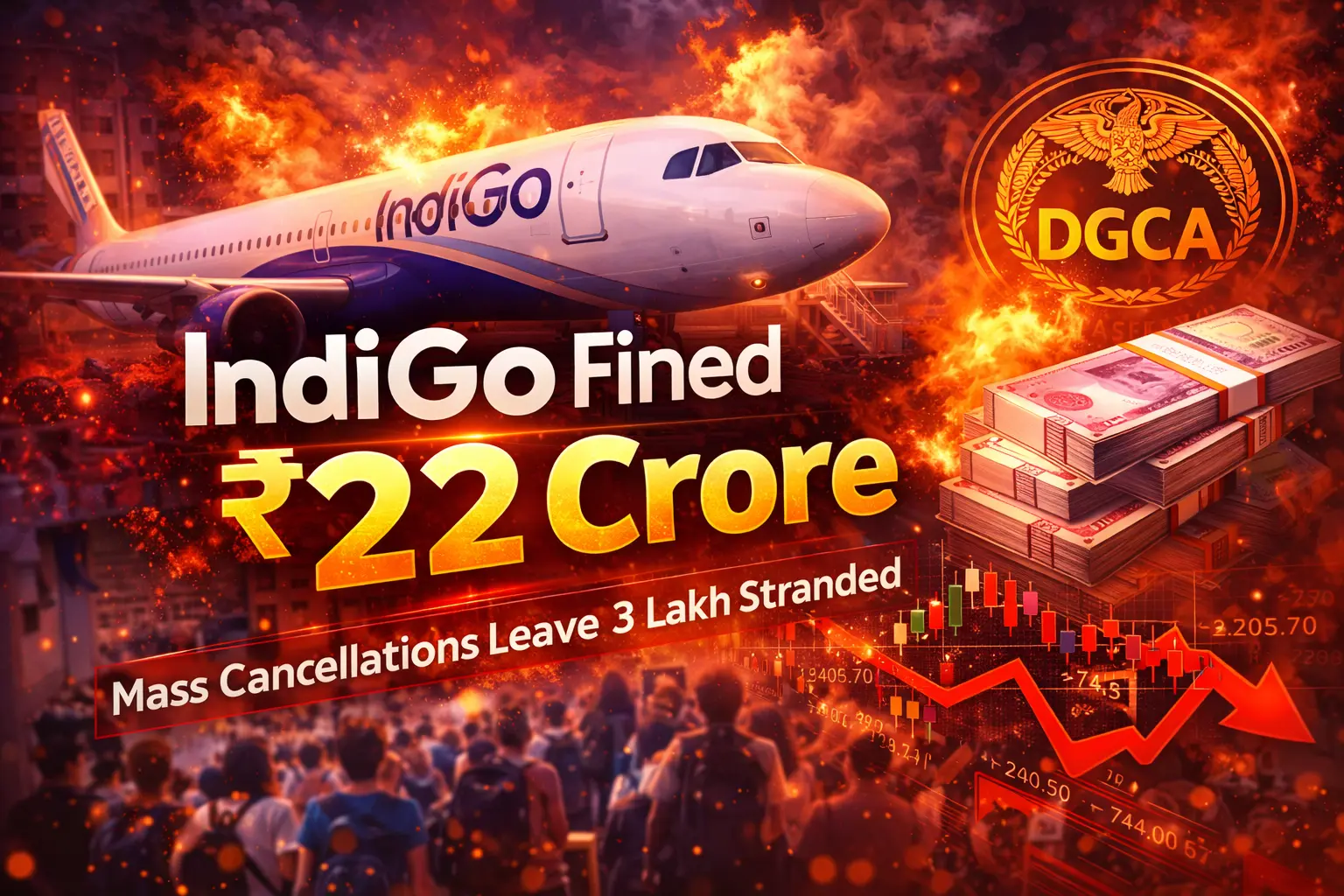
Synopsis: India’s aviation regulator has imposed a ₹22.2 crore penalty on IndiGo Airlines following a probe into massive flight cancellations and delays in December 2025 that stranded more than three lakh passengers nationwide. While the financial penalty itself is manageable, the episode has triggered heightened regulatory scrutiny, governance warnings for senior leadership, and fresh investor questions around operational resilience. The key issue now is not the fine — but whether IndiGo’s execution model can withstand India’s rapidly growing aviation demand without repeating such disruptions.
India’s largest airline is facing one of its most serious regulatory interventions in recent years.
The Directorate General of Civil Aviation (DGCA) has slapped a ₹22.20 crore fine on IndiGo after concluding that the airline’s management failed to properly assess the operational impact of revised Flight Duty Time Limitation (FDTL) rules during the winter schedule, leading to widespread chaos between December 3 and December 5, 2025.
The fallout was severe: thousands of cancelled and delayed flights, stranded passengers across multiple airports, and emergency intervention by aviation authorities.
During the three-day disruption window:
The disruption occurred during one of the busiest travel periods of the year, amplifying passenger frustration and political pressure.
While IndiGo restored operations relatively quickly, the scale of the breakdown prompted the DGCA to initiate a formal investigation into the airline’s operational planning and governance framework.
A four-member DGCA committee conducted an in-depth probe into the incident. The findings were blunt.
According to the regulator, IndiGo had pushed operational optimisation to a breaking point by:
The airline’s internal systems were reportedly not robust enough to model cascading disruptions, leaving management blind to the scale of risk building beneath the surface.
In simple terms, IndiGo’s celebrated efficiency model — long admired by investors — became a liability under stress.
The revised FDTL rules, aimed at improving crew safety and fatigue management, were implemented during the winter schedule.
DGCA found that:
When weather issues, congestion, and scheduling conflicts emerged, the system collapsed rapidly, triggering mass cancellations.
The ₹22.20 crore penalty comprises:
| Component | Amount |
|---|---|
| Systemic operational violations | ₹1.80 crore |
| Continued non-compliance (68 days) | ₹20.40 crore |
| Total fine | ₹22.20 crore |
Beyond the fine, DGCA has mandated a ₹50 crore bank guarantee, which will be released only after verified compliance across four critical reform areas:
This guarantee effectively places IndiGo under regulatory probation until reforms are implemented.
In a rare move, DGCA extended accountability to top management:
This signals a regulatory shift from blaming frontline execution to questioning boardroom decision-making and governance controls.
For investors, this elevates governance risk to the forefront.
IndiGo said its Board and management are committed to complying with DGCA’s orders and have initiated a comprehensive internal review.
The airline stated:
IndiGo also highlighted:
However, no detailed timeline for reforms has been publicly disclosed yet.
From a pure financial perspective, the fine is immaterial for IndiGo.
But markets don’t price fines — they price risk perception.
The key risk is repeat disruption, not this one-time penalty.
Is this a one-off incident or a structural flaw? That depends on whether IndiGo redesigns its planning model or merely patches it.
Will tighter regulations increase costs for airlines?
Yes. Buffer capacity, additional crew, and better systems will raise operating costs.
Could this trigger broader sector-wide scrutiny?
Very likely. The government has already asked multiple airlines to share fare and operational data.
Does this change IndiGo’s long-term growth story?
No — but it shifts focus from growth to resilience.
India’s aviation sector is growing faster than infrastructure, manpower, and regulation can adapt.
Passenger volumes are surging, but:
The IndiGo episode may become a case study for how not to scale airline operations.
For years, IndiGo has been rewarded by markets for its lean, efficient model.
But aviation is now entering a phase where:
Airlines that fail to adapt may face repeated disruptions — and repeated penalties.
The ₹22.2 crore DGCA fine is not a financial shock — it is a strategic warning.
IndiGo remains India’s aviation leader, but the December disruption exposed vulnerabilities in an over-optimised operating model. The real test now lies in execution: whether IndiGo can rebuild resilience without sacrificing profitability.
For investors, the focus shifts from market share to management quality, governance discipline, and operational robustness.
In aviation, reputation compounds slowly — but failures compound fast. IndiGo now flies under a much tighter regulatory radar, and the market will be watching every move.
⚠️ DISCLAIMER :This article is for informational and educational purposes only. It does not constitute investment advice, research recommendation, or an offer or solicitation to buy or sell any securities. The information is based on publicly available data and is believed to be accurate at the time of publication. Readers are advised to conduct their own research and consult with a qualified financial advisor before making any investment decisions. Stock market investments are subject to market risks.

Financial journalist specializing in market analysis, stock research, and investment trends. Dedicated to providing accurate, timely insights for informed decision-making.
Credentials: Experienced financial journalist with expertise in equity markets and economic analysis
The information provided in this article is for educational and informational purposes only and should not be construed as financial, investment, or legal advice. Finscann does not provide personalized investment recommendations.
For detailed terms and conditions, please read our Disclaimer and Terms of Service.
No additional articles in this category yet.