Loading market data...
Indian rupee ends marginally higher at 90.9050 per dollar as interbank dollar demand boosts forward premiums. Deep analysis on USD/INR, RBI intervention, oil price risks, forward curve signals, and hedging strategies.
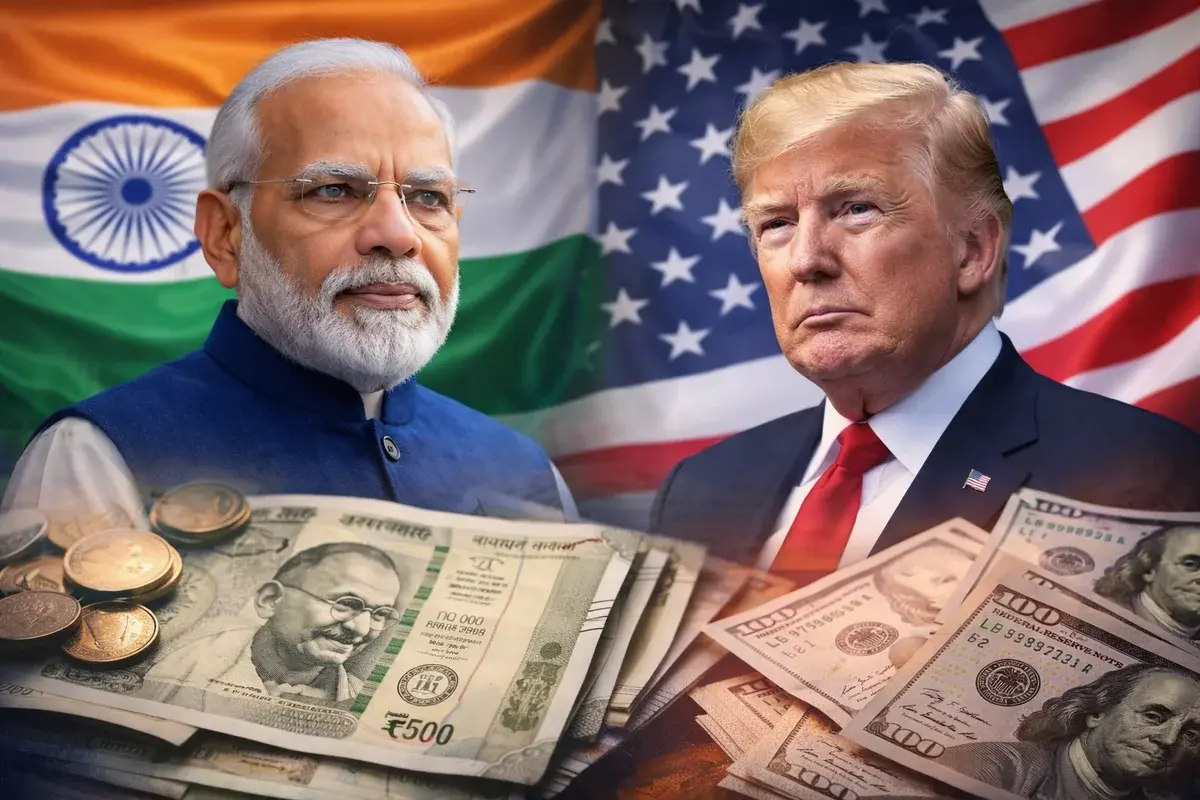
The Indian rupee closed slightly stronger at 90.9050 per dollar on February 26, 2026, supported by regional currency gains and steady dollar index levels. However, elevated dollar demand at the reference rate capped upside. Meanwhile, forward premiums firmed across tenors, with the 1-year implied yield rising to 2.65%, reflecting interbank positioning and hedging demand. For corporates and investors, the focus now shifts to oil volatility, RBI intervention cues, and anticipated capital inflows.
The Indian foreign exchange market on Thursday reflected a delicate balance between supportive regional trends and structural dollar demand pressures. While the rupee edged higher, the session underscored the persistent tug-of-war between capital flow optimism and hedging-driven dollar absorption.
The broader macro context remains complex. Global yields are stabilising, the dollar index is holding near 97.7, and the Chinese yuan is at multi-year highs providing emerging market currency support. Yet, elevated oil prices and geopolitical uncertainty continue to cloud sentiment.
For India a structurally oil-importing economy currency stability is closely tied to crude trajectories and RBI’s capital discipline in intervention strategy.
The rupee closed at 90.9050 per U.S. dollar, marginally stronger from the prior close of 90.9475.
• Regional currency strength
• Steady dollar index
• Anticipation of capital inflows
• Central bank presence near 91 per dollar
• Elevated dollar demand at reference rate
Earlier this week, the Reserve Bank of India was widely believed to have intervened to prevent a breach of the psychologically critical 91 mark a level seen as sensitive for inflation and imported cost dynamics.
Dollar demand at the RBI reference rate remained elevated due to maturity flows in the non-deliverable forwards (NDF) market. The reference rate acts as a benchmark for contract settlements and often sees concentrated positioning.
Interbank participants absorbed much of this demand, preventing sharp rupee depreciation.
This behaviour suggests two important structural trends:
Anticipation of near-term inflows
Confidence in RBI’s informal tolerance band
Dollar-rupee forward premiums rose across most maturities.
| Tenor | Premium Movement | Interpretation |
|---|---|---|
| 1-Month | 15 paisa | Mild hedging demand |
| 1-Year Implied Yield | 2.65% (+2 bps) | Mid-term rate expectations firming |
Traders reported broad-based “paying interest” in mid-to-far tenors among interbank desks indicating structured hedging activity rather than speculative positioning.
Higher forward premiums typically:
• Improve exporter hedge economics
• Raise hedging costs for importers
• Reflect tightening offshore liquidity
Lingering geopolitical tensions between the U.S. and Iran continue to influence oil markets. Analysts have warned that potential U.S. strikes could trigger a $5–10 per barrel spike in crude.
For India, higher oil prices translate to:
• Wider current account deficit
• Imported inflation pressure
• Increased dollar demand
• Potential rupee depreciation bias
The currency market remains sensitive to Brent volatility, particularly as India’s import bill scales with growth recovery.
Despite global volatility, India continues to attract structural capital:
• Stable domestic SIP inflows
• Improving corporate balance sheets
• Relative growth premium versus EM peers
Foreign portfolio flows remain tactical and closely linked to U.S. bond yield direction.
“Currency stability in the current environment hinges less on spot intervention and more on forward market positioning and capital inflow expectations,” says a Mumbai-based treasury strategist.
The forward curve steepening suggests:
• Mild tightening in rupee liquidity
• Interbank hedging preference over outright spot positioning
• Expectations of carry stability
From a macro perspective, India’s real rate differential remains attractive compared to developed markets, supporting currency carry trades provided oil volatility does not spike sharply.
• RBI’s active but calibrated intervention
• Strong FX reserves buffer
• Anticipated FPI and FDI inflows
• Stable dollar index environment
• Regional currency momentum (especially CNY strength)
• Oil price shock from geopolitical escalation
• Sudden FII outflows linked to U.S. yields
• NDF-led speculative pressure
• Importer dollar hoarding
• Inflation surprises impacting rate outlook
| Segment | Current Momentum | Outlook | Sentiment |
|---|---|---|---|
| Spot USD/INR | Stable | Range-bound 90–91.50 | Neutral |
| Forward Premiums | Rising | Firm | Hedging demand |
| Dollar Index | Steady | Data-sensitive | Balanced |
| Oil Prices | Elevated | Volatile | Risk factor |
Treasury advisors suggest:
• Exporters: Consider partial hedge bookings amid rising premiums
• Importers: Buy major dips in spot USD/INR
• Mid-term hedgers: Lock in structured positions in far tenors
The current forward curve offers a tactical opportunity window for exporters seeking yield enhancement via forward bookings.
For Currency Traders
• Watch 90.80–91.20 zone closely
• Monitor oil and U.S. yield triggers
• Track RBI reference rate patterns
For Corporate Treasuries
• Exploit elevated forward premiums
• Maintain layered hedge strategy
• Avoid panic-driven full hedging
Valuation Comfort Zone
Sustained trade above 91.30 may invite stronger RBI presence; below 90.50 could trigger exporter supply.
Market participants can access currency derivatives and hedging instruments via platforms and brokerages such as Zerodha, Groww, Upstox, and Angel One, which offer USD/INR futures, options, and forward-linked products.
Q: Why did the rupee gain despite strong dollar demand?
Interbank selling and RBI presence offset concentrated reference-rate buying.
Q: What does rising forward premium indicate?
Higher hedging demand and firmer implied yields.
Q: How does oil impact USD/INR?
Higher oil widens trade deficit, increasing structural dollar demand.
Q: Is RBI defending 91 per dollar?
Market participants perceive informal resistance near that level.
Q: Should exporters hedge now?
Rising premiums make partial hedging attractive.
The rupee’s marginal appreciation masks deeper structural crosscurrents. With oil volatility, geopolitical risk, and global yield sensitivity in play, currency stability will hinge on forward market dynamics and RBI calibration.
⚠️ DISCLAIMER: We Are Not Financial Advisors

Financial journalist specializing in market analysis, stock research, and investment trends. Dedicated to providing accurate, timely insights for informed decision-making.
Credentials: Experienced financial journalist with expertise in equity markets and economic analysis
The information provided in this article is for educational and informational purposes only and should not be construed as financial, investment, or legal advice. Finscann does not provide personalized investment recommendations.
For detailed terms and conditions, please read our Disclaimer and Terms of Service.