Loading market data...
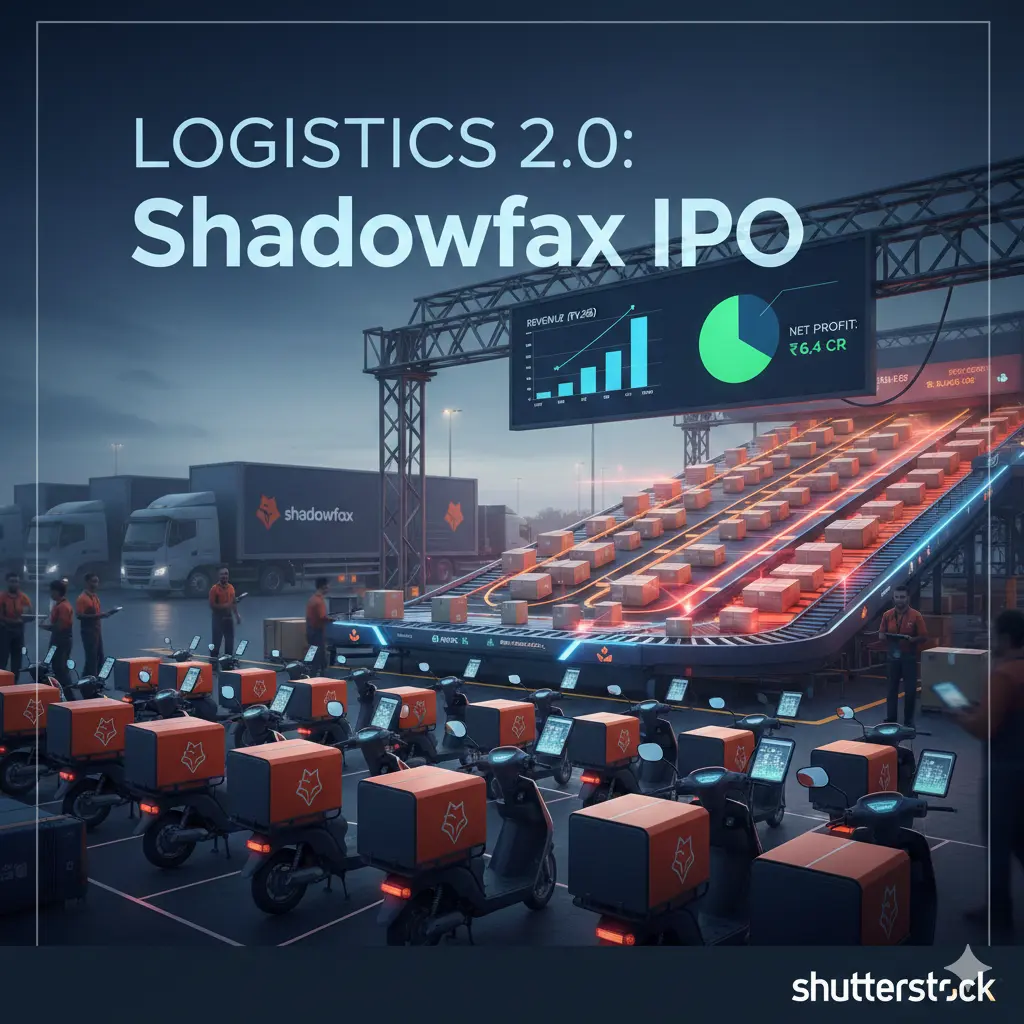
Logistics 2.0: Shadowfax’s ₹1,900-Crore IPO Bet and the "Profit First" Pivot
Synopsis: Shadowfax, the Flipkart-backed third-party logistics (3PL) disruptor, is set to launch its ₹1,900-crore IPO next week with a strategic valuation haircut to ₹7,400 crore. Moving from a peak internal target of ₹8,500 crore, the company is prioritizing "price-to-value" to court long-term institutional capital. With a massive revenue leap to ₹2,485 crore in FY25 and a decisive flip into profitability (₹6.4 Cr net profit), Shadowfax is positioning itself as the "Goldilocks" of logistics—balancing the high-velocity growth of quick commerce with the disciplined unit economics of express delivery. This offering serves as a critical bellwether for the Indian logistics-tech sector's resilience in a high-interest-rate environment.
1. The Valuation Correction: Pragmatism Over Posturing
Shadowfax’s decision to dial back its valuation from an ambitious ₹8,500 crore to ₹7,400 crore reflects a broader "valuation reset" across the Indian startup ecosystem. In a market that has recently punished high-growth but cash-burning tech entities, Shadowfax is choosing a conservative entry point to ensure a "pop" for retail investors and sustained interest from Foreign Institutional Investors (FIIs). This 13% haircut is a tactical maneuver to avoid the P/E compression witnessed by some of its listed peers. By leaving "money on the table," the company signals a shift from the growth-at-all-costs era to a sustainability-first model, aiming to generate alpha for its new shareholders from day one.
2. The OFS Dynamic: Blue-Chip Exit or Vote of Confidence?
The ₹1,900-crore issue is split between a ₹1,000-crore fresh issue and a ₹900-crore Offer for Sale (OFS). While an OFS is often scrutinized as a "liquidity event" for early backers, the roster of participating sellers—including Flipkart Internet, Eight Roads, and Qualcomm Asia Pacific—suggests a strategic portfolio rebalancing rather than a lack of conviction. The fresh capital infusion of ₹1,000 crore is earmarked for a massive offensive: expanding network infrastructure, optimizing its proprietary AI-driven routing engines, and aggressively scaling its "Flash" service to dominate the burgeoning quick commerce fulfillment space.
3. Financial Fortitude: The Turnaround Story in Numbers
The most compelling narrative in the Shadowfax prospectus is its financial trajectory. The company has successfully transitioned from a loss of ₹142.6 crore in FY23 to a net profit of ₹6.4 crore in FY25. Even more impressive is the H1 FY26 performance, where net profits surged by 114% to ₹21 crore. This expansion is driven by improved operating leverage and a tightening of EBITDA margins, which climbed to 2.86% in the first half of the current fiscal year.
Shadowfax: Key Financial Snapshot (FY23–FY25)
| Metric | FY23 | FY24 | FY25 | H1 FY26 (Annualized) |
|---|---|---|---|---|
| Operating Revenue (₹ Cr) | 1,415.1 | 1,884.8 | 2,485.1 | ~3,610 |
| Net Profit / (Loss) (₹ Cr) | (142.6) | (11.9) | 6.4 | 42.1 (Est.) |
| Adj. EBITDA Margin (%) | (7.18%) | 1.02% | 1.96% | 2.86% |
| Debt-to-Equity Ratio | N/A | 26.2% | 20.0% | ~18.5% |
4. The Quick Commerce Edge: Differentiating from Delhivery
Unlike its primary listed competitor, Delhivery, which maintains a significant focus on B2B freight and large-scale e-commerce, Shadowfax has carved a moat in the hyperlocal and quick commerce segments. Holding an estimated 50% market share in third-party quick commerce fulfillment, it acts as the "invisible backbone" for platforms like Flipkart Minutes and BigBasket. Its asset-light model, powered by over 200,000 quarterly transacting delivery partners, allows for high product velocity without the heavy capital drag of a fully owned fleet.
Expert Insight: "Shadowfax's move to public markets is a test of whether investors value 'niche dominance' over 'horizontal scale.' Their ability to maintain a capital turnover ratio of 3.96x—the highest in its peer group—suggests that their technology is truly extracting more value per rupee of asset than traditional players. The market is looking for profitable growth, and Shadowfax's H1 FY26 numbers provide a very strong tailwind." — Pratik Shah, Lead Analyst at CapitalVantage.
5. Operational Scale and Infrastructure Expansion
Shadowfax is not just a software layer; it is a physical behemoth. With 4,299 touchpoints across 14,758 pin codes, the company covers nearly 100% of India's e-commerce-active geography. The IPO proceeds of ₹423 crore dedicated to network infrastructure and ₹139 crore for new sortation centers indicate a push to move deeper into Tier-3 and Tier-4 markets. This "rurban" expansion is critical as the next 100 million e-commerce users are expected to emerge from non-metro regions where logistics complexity—and thus, the premium for 3PL expertise—is highest.
6. The "Risk Factor" Checklist: Client Concentration and Gig Risks
Despite the bullish outlook, investors must weigh significant risks. The company’s client concentration is high, with the top five clients contributing nearly 85% of revenue. Any shift in Flipkart’s internal logistics strategy or a cooling of the quick commerce frenzy could impact Net Interest Margins and top-line growth. Furthermore, as a "gig economy" leader, Shadowfax is sensitive to regulatory shifts regarding the Social Security Code for platform workers, which could potentially inflate labor costs and compress the hard-won EBITDA margins.
Summary of Strategic Outlook
Shadowfax enters the public arena at a time when the Indian logistics sector is projected to reach $357 billion by 2030. Its unique blend of hyperlocal agility and e-commerce scale, combined with a disciplined pivot to profitability, makes it one of the most anticipated listings of 2026. If the market rewards the conservative pricing, it could spark a fresh wave of IPOs from logistics-tech peers like Shiprocket and Porter.
⚠️ DISCLAIMER: We Are Not Financial Advisors. This article is for informational purposes only and does not constitute investment advice. Initial Public Offerings (IPOs) involve significant risk. Please consult a SEBI-registered financial advisor before making any investment decisions.

Financial journalist specializing in market analysis, stock research, and investment trends. Dedicated to providing accurate, timely insights for informed decision-making.
Credentials: Experienced financial journalist with expertise in equity markets and economic analysis
The information provided in this article is for educational and informational purposes only and should not be construed as financial, investment, or legal advice. Finscann does not provide personalized investment recommendations.
For detailed terms and conditions, please read our Disclaimer and Terms of Service.
No additional articles in this category yet.