Loading market data...
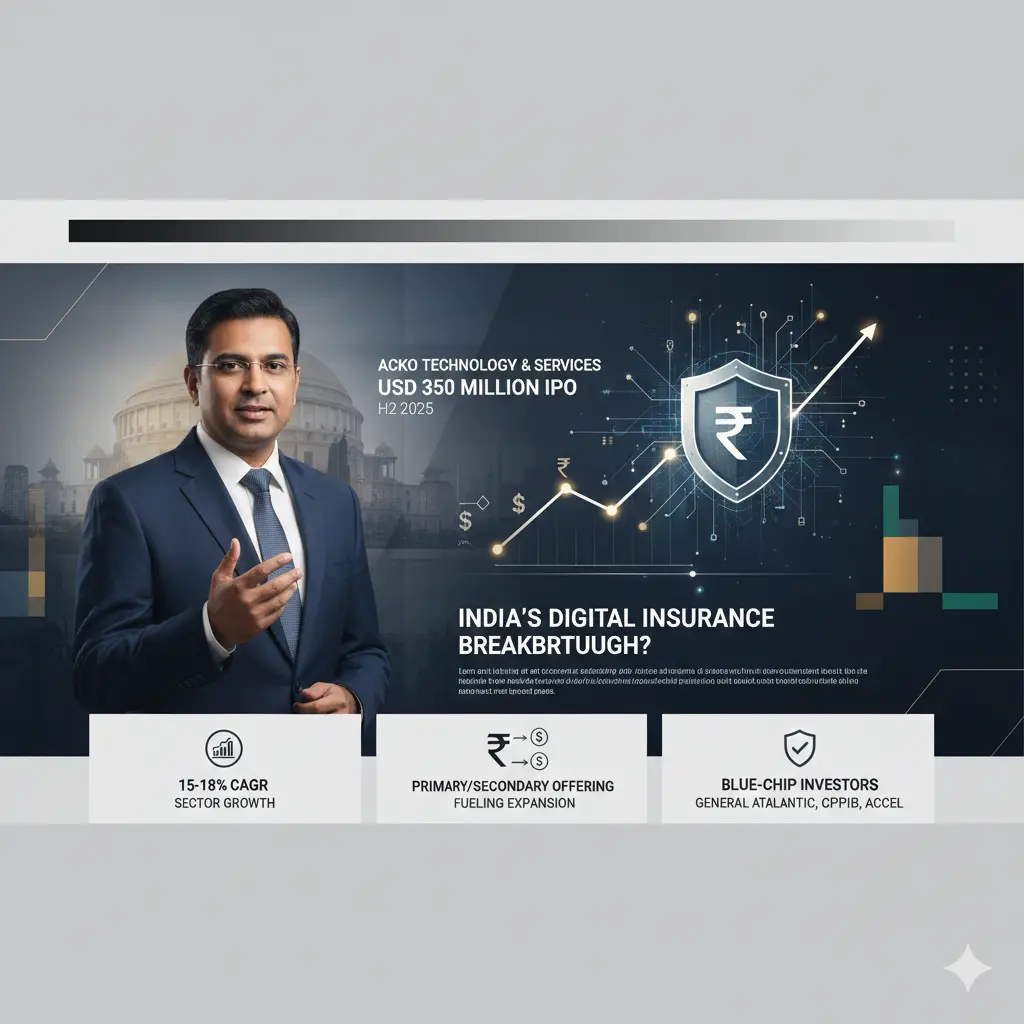
Acko's $350 Million Play: Can Digital Insurance Finally Break India's IPO Jinx?
Synopsis Acko Technology & Services is orchestrating a $350 million IPO for H2 2025, marking one of the most anticipated digital insurance listings in India's fintech landscape. Backed by blue-chip investors including General Atlantic, CPPIB, and Accel, the company plans a mixed primary-secondary structure that could unlock significant alpha for early backers while fueling expansion in a sector projected to grow at 15-18% CAGR through 2030. The move signals a critical inflection point: either validating the tech-enabled insurance thesis or exposing the challenges of margin compression in a capital-intensive, regulatory-heavy vertical. With India's IPO pipeline showing signs of revival, Acko's performance could determine whether insurtech commands premium valuations or faces the same skepticism that has plagued recent new-age listings.
The Hook
India's insurance sector is undergoing a silent revolution, and it's happening entirely online. As traditional insurers grapple with legacy infrastructure and distribution bottlenecks, a new breed of digital-first players is rewriting the playbook—and Acko Technology & Services is leading the charge.
The Bengaluru-based insurtech is now preparing to test public market appetite with a proposed $350 million initial public offering, slated for the second half of 2025. This isn't just another tech IPO; it's a referendum on whether India's capital markets are ready to reward technology-driven business models in a sector historically dominated by brick-and-mortar giants and agent-led distribution.
With investment banks already receiving pitch decks and advisory mandates expected imminently, Acko's listing could become the bellwether for insurtech valuations across Asia's third-largest economy. The question investors are asking isn't if digital insurance will disrupt the industry—it's when the unit economics will justify the valuations.
1. The Capital Architecture: Decoding the $350 Million Structure
Acko's proposed IPO combines both primary capital raise and secondary share sales—a hybrid structure that signals confidence from both the company and its existing investors. This dual-track approach serves multiple strategic purposes:
Primary Component:
Secondary Component:
| Metric | Implication |
|---|---|
| Deal Size | $350M positions Acko among top-tier fintech IPOs |
| Structure | Mixed primary-secondary reduces dilution concerns |
| Timing | H2 2025 aligns with anticipated market recovery |
| Investor Base | Marquee backers reduce execution risk |
The fact that discussions remain fluid—with terms still under negotiation—isn't unusual for this stage. However, it does introduce variables around final valuation, which could range anywhere from $1.5 billion to $2.5 billion based on comparable insurtech multiples and recent funding round data.
Expert Insight "Acko's move to combine primary and secondary shares is tactically astute. It signals that existing investors believe there's upside beyond their current entry points, while also providing liquidity that validates years of private market value creation. The real test will be demonstrating positive unit economics at scale—something few digital insurers globally have achieved." — Anonymous Banking Source, Investment Banking Division
2. The Backer Consortium: Blue-Chip Validation or Valuation Pressure?
Acko's cap table reads like a who's-who of institutional capital, featuring:
This constellation of investors brings more than just capital—it provides:
✓ Operational Expertise: General Atlantic's portfolio includes global insurance and fintech leaders
✓ Patient Capital: CPPIB's long-term investment horizon aligns with insurance business cycles
✓ Network Effects: Accel's ecosystem connects Acko to potential distribution partners
✓ Regulatory Navigation: Institutional investors often facilitate engagement with IRDAI and policymakers
However, the secondary sale component also creates potential overhang concerns. If large institutional investors reduce positions significantly, it could signal:
⚠️ Concerns about near-term profitability timelines
⚠️ Rebalancing of portfolio exposure to high-growth, high-risk assets
⚠️ Pressure to deliver returns after extended holding periods
3. Business Model Deep Dive: Product Velocity Meets Margin Pressure
Acko has built its franchise around three core verticals:
Motor Insurance
Health Insurance
Travel & Specialty Insurance
The digital-first model delivers operational advantages:
| Metric | Traditional Insurers | Acko's Digital Model |
|---|---|---|
| Policy Issuance Time | 2-5 days | Instant (< 5 minutes) |
| Commission Costs | 15-20% | 3-7% (reduced intermediation) |
| Claims Processing | 7-15 days | 24-48 hours (automated) |
| Customer Acquisition Cost | High (agent-dependent) | Lower (tech-enabled) |
The Profitability Question:
Despite operational efficiencies, digital insurers face structural challenges:
🔴 Loss Ratios: Motor insurance typically runs 85-95% loss ratios, leaving thin underwriting margins
🔴 Customer Acquisition Costs: Digital marketing and partnerships require sustained spending
🔴 Regulatory Capital: IRDAI requirements mandate capital buffers that pressure ROE
🔴 Scale Economics: Profitability often requires minimum premium thresholds Acko may still be approaching
Expert Insight
"The digital insurance thesis hinges on achieving operational leverage faster than traditional players while maintaining disciplined underwriting. Acko's technology stack reduces processing costs by 40-60%, but the real value creation comes from data-driven risk selection that improves combined ratios over time. Investors will scrutinize whether premium growth is sustainable or driven by unsustainable subsidies."
— Senior Equity Analyst, Large-Cap Institutional Fund
4. The Macro Catalyst: India's Insurance Penetration Gap
Acko's IPO timing aligns with a secular tailwind that could drive a decade of growth:
Penetration Metrics:
Growth Drivers:
Market Size Projections:
| Year | Non-Life Premium (₹Cr) | Digital Share (%) | Acko TAM Estimate |
|---|---|---|---|
| 2024 | ₹3,00,000 | 12-15% | ₹36,000-45,000 Cr |
| 2027E | ₹4,50,000 | 22-25% | ₹99,000-1,12,500 Cr |
| 2030E | ₹6,75,000 | 35-40% | ₹2,36,250-2,70,000 Cr |
Source: Industry estimates, IRDAI data
The inflection point is clear: as digital penetration crosses 20%, network effects and scale economies begin to favor tech-enabled players disproportionately.
5. Competitive Landscape: The Battle for Digital Supremacy
Acko operates in an increasingly crowded field, with both legacy players and new-age startups vying for market share:
Pure-Play Digital Insurers:
Legacy Players with Digital Arms:
Embedded Insurance Platforms:
Competitive Positioning Heatmap:
| Player | Tech Stack | Distribution | Brand Equity | Capital Base |
|---|---|---|---|---|
| Acko | ⚫⚫⚫⚫⚫ | ⚫⚫⚫⚪⚪ | ⚫⚫⚫⚪⚪ | ⚫⚫⚫⚫⚪ |
| Digit | ⚫⚫⚫⚫⚪ | ⚫⚫⚫⚫⚪ | ⚫⚫⚫⚫⚪ | ⚫⚫⚫⚫⚫ |
| HDFC ERGO | ⚫⚫⚫⚪⚪ | ⚫⚫⚫⚫⚫ | ⚫⚫⚫⚫⚫ | ⚫⚫⚫⚫⚫ |
| PhonePe | ⚫⚫⚫⚫⚪ | ⚫⚫⚫⚫⚫ | ⚫⚫⚫⚫⚪ | ⚫⚫⚫⚪⚪ |
(⚫ = Strong, ⚪ = Developing)
Acko's differentiation lies in its full-stack technology ownership and data science capabilities for risk assessment. Unlike platforms that aggregate third-party products, Acko underwrites its own policies, controlling the entire value chain from customer acquisition to claims settlement.
6. Valuation Framework: What's Acko Really Worth?
Determining fair value for a pre-profitable, high-growth digital insurer requires multiple lenses:
Comparable Public Companies:
Private Market Precedents:
Key Valuation Drivers:
📊 Premium Growth Rate: 40-50% CAGR justifies growth premium
📊 Combined Ratio: Target of sub-100% critical for underwriting profitability
📊 Customer LTV/CAC: Need 3:1+ ratio for sustainable unit economics
📊 Market Share Trajectory: Path to 5%+ share in core segments
Bull Case ($2.5B+ valuation):
Bear Case ($1.0-1.5B valuation):
7. Risks & Challenges: The Roadblocks to Success
No IPO story is complete without acknowledging potential pitfalls:
Regulatory Risk:
Technology Risk:
Market Risk:
Execution Risk:
Financial Risk:
Expert Insight
"The biggest risk for Acko isn't competition—it's the temptation to prioritize growth over underwriting discipline. Insurance is ultimately a risk-selection business. Companies that chase premiums without maintaining strict loss ratio targets inevitably face capital destruction. Acko's management team must demonstrate they can balance aggressive scaling with actuarial rigor."
— Former Insurance CEO, Now Independent Director
8. The Investor Playbook: Who Should Buy In?
Not every investor profile aligns with Acko's risk-reward proposition:
✅ Suitable For:
❌ Potentially Unsuitable For:
Key Monitoring Metrics Post-IPO:
| Metric | Target | Why It Matters |
|---|---|---|
| Gross Written Premium (GWP) Growth | 35-45% YoY | Indicates market share capture |
| Combined Ratio | <105% | Path to underwriting profitability |
| Customer Retention Rate | >70% | Validates product-market fit |
| Operating Expense Ratio | Declining trajectory | Shows operational leverage |
| Regulatory Capital Adequacy | >150% | Financial stability buffer |
9. The IPO Pipeline Context: Timing Is Everything
Acko's offering doesn't exist in isolation—it's part of a broader revival in India's IPO markets after a challenging 2023:
Recent Fintech/Tech Listings:
H2 2025 Expected Pipeline:
Market Sentiment Indicators:
🟢 Positive Factors:
🔴 Headwinds:
The success or failure of Acko's IPO could set the tone for subsequent insurtech and fintech listings, making it a critical market test.
10. Looking Ahead: What Happens Next?
As Acko finalizes its advisors and roadshow plans, here's the expected timeline and key milestones:
Q2 2025:
Q3 2025:
Q4 2025:
Post-Listing Focus Areas:
The Bigger Picture:
Acko's IPO represents more than a company going public—it's a test of whether India's capital markets will reward technology-enabled disruption in traditional sectors. A successful listing could:
✓ Unlock valuations for dozens of private insurtech startups
✓ Attract more global capital to India's digital insurance sector
✓ Accelerate incumbents' digital transformation investments
✓ Validate the thesis that technology can create sustainable competitive advantages in financial services
Conversely, a disappointing performance could:
✗ Delay IPO plans for peer companies waiting in the wings
✗ Force a repricing of private market valuations across the sector
✗ Increase scrutiny on unit economics and profitability timelines
✗ Shift investor preference back toward profitable, traditional players
⚠️ DISCLAIMER: We Are Not Financial Advisors
This article is for informational and educational purposes only and does not constitute financial, investment, legal, or tax advice. The analysis presented reflects publicly available information and industry perspectives as of the publication date. Investing in IPOs carries significant risks, including loss of principal, volatility, and execution uncertainty.
Past performance of similar companies does not guarantee future results. Readers should conduct their own due diligence, consult with qualified financial advisors, and carefully review the company's prospectus before making any investment decisions. The author and publication hold no positions in Acko Technology & Services or related entities and have received no compensation for this coverage.
Regulatory Note: IPO investments are subject to SEBI regulations, lock-in periods, and market risks. Ensure you understand all terms and conditions before participating in any public offering.

Financial journalist specializing in market analysis, stock research, and investment trends. Dedicated to providing accurate, timely insights for informed decision-making.
Credentials: Experienced financial journalist with expertise in equity markets and economic analysis
The information provided in this article is for educational and informational purposes only and should not be construed as financial, investment, or legal advice. Finscann does not provide personalized investment recommendations.
For detailed terms and conditions, please read our Disclaimer and Terms of Service.
No additional articles in this category yet.