Loading market data...
Russia and Iran deepen crude oil discounts to attract Chinese buyers after India cuts imports, intensifying competition in Asia’s energy market and reshaping global oil trade dynamics.
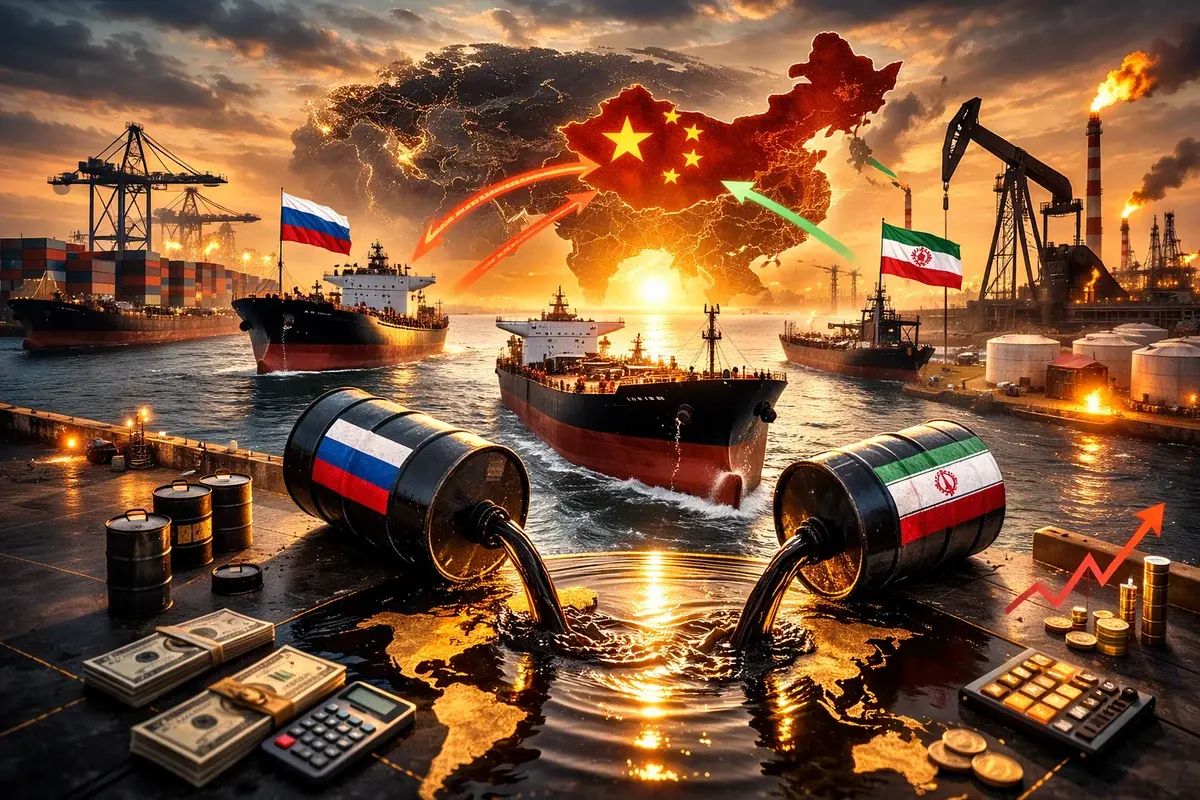
Russian and Iranian crude exporters are aggressively widening discounts to retain market share in China after India sharply reduced its purchases of Russian oil. The shift is triggering heightened price competition in Asia’s largest energy market, reshaping regional crude trade flows.
India’s pullback is redirecting displaced Russian cargoes toward China, where Moscow now competes directly with Tehran for a limited pool of refiners.
India had emerged as one of the largest buyers of discounted Russian crude following Western sanctions. However, recent data suggests a steep correction.
According to Rystad Energy, India’s imports of Russian oil are projected to fall nearly 40 percent to around 600,000 barrels per day. That decline is forcing Russia to redirect volumes toward China.
| Destination | Previous Volume Trend | Current Outlook |
|---|---|---|
| India | High Post-Sanctions Intake | ↓ 40% Reduction |
| China | Stable Purchaser | Rising Intake |
| Other Asian Markets | Selective | Competitive |
This realignment has intensified price competition in China, particularly among independent refiners.
Russia and Iran are offering deeper discounts relative to global benchmarks to secure Chinese buyers.
| Crude Grade | Discount vs ICE Brent | Previous Discount |
|---|---|---|
| Russia Urals | ~$12 per barrel | ~$10 |
| Iranian Light | ~$11 per barrel | ~$8–9 |
The widening discount gap underscores the urgency both exporters face in protecting market share.
The global benchmark used for comparison, ICE Brent, remains the primary pricing reference for international crude contracts.
China’s independent refiners, often called “teapots,” have historically absorbed sanctioned or discounted crude. However, their capacity is constrained.
| Refinery Type | Share of Total Processing Capacity | Constraints |
|---|---|---|
| State-Owned | Majority | Policy-driven imports |
| Independent “Teapots” | ~25% | Import quotas, regulatory limits |
With government-imposed import quotas limiting teapot purchases, both Russia and Iran face structural bottlenecks in expanding sales.
The intensified competition in China could have several implications:
| Factor | Impact |
|---|---|
| Discount Expansion | Lower revenue per barrel |
| Volume Redirection | Higher logistics costs |
| Sanctions Pressure | Limited buyer pool |
| Pricing Volatility | Revenue unpredictability |
For Russia, maintaining export volumes is crucial for fiscal stability. For Iran, sustaining oil flows is equally important amid continued geopolitical restrictions.
The current situation reflects deeper structural shifts in global oil markets.
Following sanctions and geopolitical tensions, Asian markets have become critical outlets for both Russia and Iran. China’s leverage as the dominant buyer gives it negotiating power in securing discounted barrels.
| Driver | Market Effect |
|---|---|
| Geopolitical Sanctions | Trade rerouting |
| India’s Import Reduction | Oversupply in Asia |
| Chinese Demand Cycles | Price sensitivity |
| Global Benchmark Movements | Discount recalibration |
The competitive discounting could temporarily weigh on regional crude pricing spreads.
Both Russia and Iran have increasingly relied on China as a strategic buyer in recent years. This concentration risk becomes more pronounced when alternative markets shrink.
China’s purchasing decisions now directly influence:
The evolving dynamics underscore China’s central role in shaping Asian crude pricing structures.
If India’s reduced intake persists, several outcomes are possible:
• Prolonged discount competition in Asia • Increased freight and insurance costs • Greater Chinese bargaining leverage • Pressure on exporter fiscal balances
Additionally, sustained discounting could influence global Brent spread stability.
The coming months will determine whether the current discount war stabilizes or escalates further. Key variables to monitor include:
• India’s future import policy • China’s refinery utilization rates • Global crude benchmark trends • Geopolitical developments
As Russia and Iran recalibrate export strategies, the competitive landscape in Asia may continue evolving, with China at the center of pricing power.

Financial journalist specializing in market analysis, stock research, and investment trends. Dedicated to providing accurate, timely insights for informed decision-making.
Credentials: Experienced financial journalist with expertise in equity markets and economic analysis
The information provided in this article is for educational and informational purposes only and should not be construed as financial, investment, or legal advice. Finscann does not provide personalized investment recommendations.
For detailed terms and conditions, please read our Disclaimer and Terms of Service.
Gold vs Silver in India: Compare latest prices, state-wise and city-wise rates, market trends, volatility, and investment outlook for both precious...
Silver prices in India trade near the upper range amid strong industrial demand and global bullion momentum.

Gold prices in India trade near ₹1.62 lakh per 10 grams as global uncertainty, rupee movement, and central bank demand support bullion.
Oil prices surge to 7-month highs as US-Iran talks loom, impacting global supply & demand. FinScann analyzes the outlook for crude, energy stocks,...
Silver ETFs jumped over 6% while gold ETFs gained 2% after the US Supreme Court struck down Trump-era tariffs, weakening the dollar and boosting...