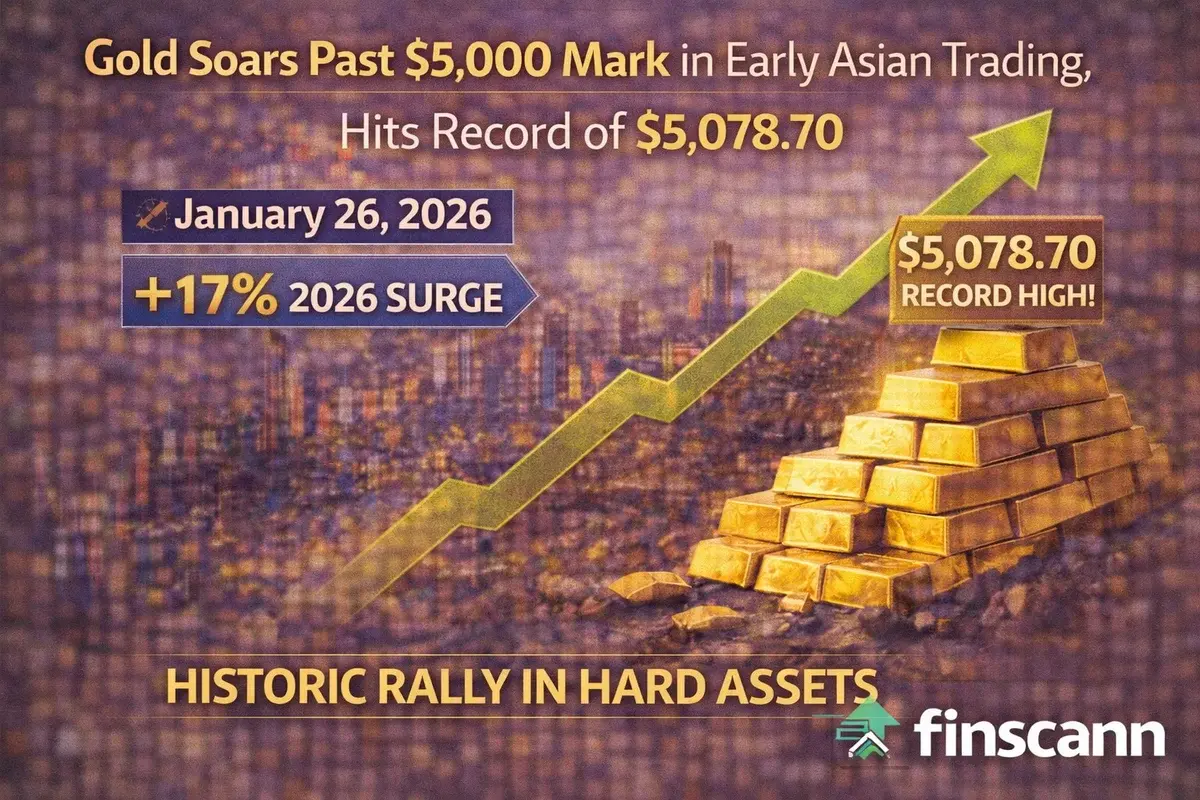
In a move that has rewritten financial history, gold prices surged past the $5,000 per troy ounce mark in early Asian trading on Monday, January 26, 2026. This historic rally—pushing bullion to a record high of $5,078.70—signals a profound shift in global market sentiment as investors flee traditional fiat currencies and bonds in favor of "hard assets."
The breakthrough represents a 17% gain in the first three weeks of 2026 alone, an acceleration that has stunned even the most bullish analysts who expected this milestone much later in the year.
The surge isn't just a technical breakout; it is the result of a "perfect storm" of geopolitical and fiscal triggers that converged over the weekend.
- The "Greenland Friction": Tensions between the U.S. and NATO over the sovereignty of Greenland have reached a boiling point. Markets were unsettled by reports of aggressive trade rhetoric and tariff threats directed at European allies, fueling a "Sell America" sentiment.
- Fiscal Anxiety: Growing concerns over U.S. debt dynamics and a potential government shutdown have weakened the U.S. Dollar Index (DXY), which is currently hovering near multi-month lows around 98.33.
- Central Bank "De-Dollarization": Emerging market central banks, led by China and India, have continued their massive gold-buying spree. China recently extended its accumulation for a fourteenth consecutive month, treating gold as a structural hedge against Western sanctions and dollar volatility.
Gold isn't the only metal making headlines. The "gold fever" has ignited a massive secondary rally in silver and other precious metals.
- Silver’s Milestone: For the first time in history, spot silver has broken above the $100 per ounce barrier, trading at $105.54. Silver is currently outperforming gold in percentage terms due to its dual role as a safe-haven and a critical industrial component in the 2026 green-energy infrastructure boom.
- Platinum and Palladium: Both metals are seeing multi-year highs as industrial supply chains brace for further trade war disruptions.
| Metal | Price (Jan 26, 2026) | 2026 YTD Gain |
|---|
| Gold | $5,078.70 | +17.2% |
| Silver | $105.54 | +24.5% |
| Platinum | $2,766.30 | +12.1% |
In early 2026, gold is no longer just a physical bar in a vault; it has become a core institutional asset.
- ETF Inflows: Gold ETFs saw record inflows in December 2025, and that momentum has doubled in January. Professional money managers are increasingly allocating 5-15% of their portfolios to gold, moving away from the traditional 60/40 (stock/bond) model.
- Gold Stablecoins: The rise of digital "Gold Stablecoins" (like Tether Gold) has allowed retail and crypto-native investors to participate in the rally, with the market cap for gold-backed digital assets jumping 22% this month.
While the $5,000 mark is a massive psychological victory, the market is now in "uncharted territory."
- The Bull Case: Analysts at Goldman Sachs and J.P. Morgan have already revised their year-end targets toward $5,500 - $6,000, citing that the structural shift in central bank behavior has no near-term reversal.
- The Bear Risk: A sudden resolution to the "Greenland dispute" or a hawkish surprise from the Federal Reserve later this week could trigger a sharp bout of profit-taking.
FinScann Take:
We are witnessing the "Gold Standard" returning by stealth. As inflation remains sticky and geopolitical alliances fracture, the global economy is anchoring itself to the only asset that carries no counterparty risk. For investors, the question is no longer "is gold too expensive," but "how much dollar-denominated risk can I afford to keep?"